Insight
AI in Trading: How Artificial Intelligence is Changing the Stock Market
13 min read · Updated 2 Nov 2026
The phrase "AI in trading" is doing a lot of work in 2026. It covers everything from genuine breakthroughs - LLMs that can read a balance sheet faster than an analyst - to outright snake oil ("our neural network predicts tomorrow's close with 87% accuracy"). The signal and the noise are mixed in roughly equal measure.
This piece separates them. We'll cover what AI is actually doing in markets right now, what's overhyped, what's emerging, and where retail traders can use AI today without falling for marketing. Where Unfluke fits in is treated honestly - as one specific implementation of AI for retail research, not as proof that AI predicts prices.
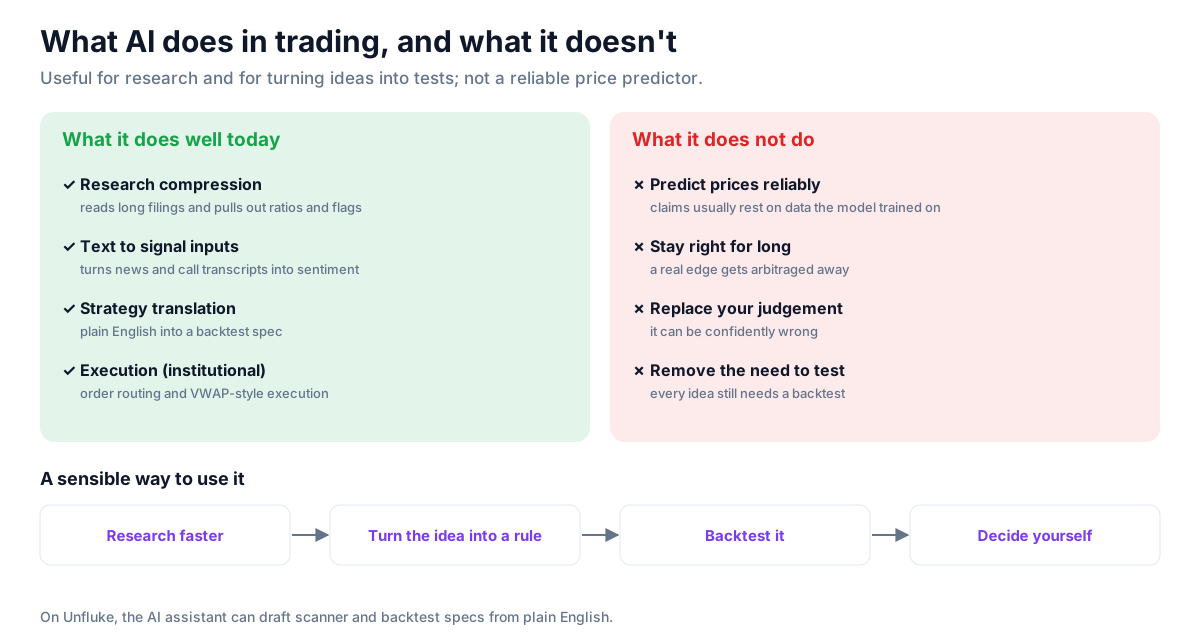
What AI actually does in trading today
Strip away the marketing and AI in trading does four things well today:
- Research compression. An LLM can read a 200-page annual report and extract the relevant ratios, flags, and changes in 30 seconds. That doesn't make it a better analyst - but it makes a good analyst dramatically faster.
- Pattern surfacing in unstructured data. Sentiment from earnings call transcripts, news flow, social chatter. AI is genuinely useful for turning a torrent of text into a structured signal.
- Strategy generation and translation. Describe a strategy in plain English, get back a structured backtest spec. This is what Unfluke's AI chatbot does, and it's where LLMs add real value for retail traders.
- Execution optimisation (institutional only). Smart order routing, market impact minimisation, VWAP-tracking execution algos - long-solved but increasingly ML-driven.
What AI does NOT do (yet) - predict prices
The headline claim of most retail AI trading products is prediction. "Our AI predicts tomorrow's close." With near-zero exceptions, these products either:
- Test on the data they trained on (so "accuracy" is fictitious)
- Use sample sizes too small to be statistically meaningful
- Are silent when their model is wrong - survivorship in the marketing
- Trade on patterns that disappear the moment any real money tries to use them
The mathematical reason: financial markets are an adversarial system where every profitable signal gets arbitraged away. AI that finds a real edge has it priced out within months, sometimes days. Persistent prediction accuracy in markets - at any scale that matters - is the rarest commodity in finance.
If a retail AI tool tells you it predicts prices, it doesn't. Use it for research, not signals.
LLMs: the genuine breakthrough
Large language models are the first genuinely new technology for financial research since the spreadsheet. A well-prompted LLM can extract balance-sheet flags, summarise an earnings call, generate a screener spec from a sentence, or explain a strategy backtest result. None of these are predictions - they're acceleration of human work. This is where the value is real and growing.
Sentiment analysis - useful but lossy
Reading news flow, earnings transcripts, and social media for sentiment is one of AI's older trading applications and still useful. Where it falls down: most sentiment models are trained on English-language financial text and miss Indian context (Hindi, regional sources, broker reports). Even within English, sarcasm and irony are routinely misread. Sentiment is a useful one-of-many inputs, never a standalone signal.
What's happening in the Indian market specifically
India's retail AI trading scene exploded between 2023 and 2026. Some highlights of what's actually working:
- Fundamental Q&A bots that answer "What's the debt-to-equity ratio of Infosys?" without you opening an annual report. Genuine time-saver.
- Strategy-from-sentence backtest assistants that turn "Test a 9:20 short straddle on Bank Nifty with 30% SL" into a runnable backtest. Real productivity for retail.
- YouTube strategy parsers that watch a trading strategy video and turn it into testable rules. Sounds gimmicky until you've actually tried backtesting a strategy from a YouTube channel by hand.
- Fundamental screeners from English - instead of ticking 12 filters, type "midcap names with P/E under 25 and ROE above 18%". Faster than dropdowns once you're past the novelty.
Unfluke's AI chatbot ships six bot types covering exactly these use cases. See the chatbot overview for details.
AI vs traditional quant - what's the difference?
"Quant" trading has used statistical models for decades. Most high-frequency trading and arbitrage strategies are quantitative, not AI in the modern sense. The shift in 2024-26 is:
- Traditional quant: hand-built models, statisticians, structured data, hypothesis-driven.
- Modern AI: model-driven, capable of unstructured data, less interpretable, faster to iterate.
Both work. AI hasn't replaced quant - it's expanded the toolkit. Many shops now run hybrid models with traditional statistical signals augmented by AI-derived features (sentiment scores, entity extraction, theme classification).
What's emerging - and what to watch in 2026-27
Three trends to watch: (1) AI-native backtesting platforms that generate strategies from intent rather than rules; (2) multimodal models that incorporate news video and audio alongside text; (3) agentic systems that research, paper-trade, and report autonomously. All three are early. None of them yet beat disciplined human research on retail-scale capital. But the trajectory is real.
How retail traders should use AI in 2026
- Yes: as a research assistant - read filings, summarise calls, draft scanner specs, debug backtests.
- Yes: as a strategy translator - describe an idea, get back a structured backtest.
- Yes: as a sanity checker - paste your trade journal and ask "what's the most common mistake here?".
- No: as a price predictor.
- No: as a replacement for understanding why your strategy works.
- No: as anything you trade blindly. Every AI output is a draft, not a decision.
Strategy ideas (ideas, not promises)
These are ideas to study, paper-trade and backtest, not recommendations or signals, and not a promise of any result. AI output can be wrong or out of date; treat it as a draft. Size, entries, exits and risk are your own decisions.
1. Use AI to compress research
- Setup: ask an assistant to summarise a company's last few quarters before you read the filings.
- Use: you start the real reading knowing what to look for.
2. Turn an idea into a testable rule
- Setup: describe a strategy in plain English and let the AI draft the backtest spec.
- Use: check the spec, then test it; the test, not the AI, tells you whether it held up.
3. Use sentiment as one input
- Setup: note the tone of results commentary alongside price and volume.
- Invalidation: never act on a sentiment score alone.
How to test these
Run every AI-drafted idea through a backtest on Unfluke and compare it with a simple baseline.
Honest caveats
AI in trading is one of the most heavily marketed technologies in modern finance. Most of what's sold to retail traders as "AI" is either rebranded statistics or pure marketing. The genuine applications - research compression, sentiment, strategy translation - don't make most marketing copy because they don't sound impressive. They just save you time. AI does not beat the market. Disciplined traders, with or without AI, sometimes do.
Try Unfluke's AI chatbot
Unfluke ships six AI bot types - Company Fundamentals, Fundamental Screener, Scanner, Basic Backtest, Advanced Backtest, and a YouTube Strategy parser. Free tier includes 5 messages a month; paid tiers raise the quota. Sign up free or read the full AI Chatbot overview.
More from the blog
- Strategy Backtesting on Unfluke
Backtest trading strategies on real Indian market data with Unfluke. Test equity, Nifty, Bank Nifty and options strategies with realistic costs and key metrics.
- Live Market Scanners
Explore Unfluke's real-time stock scanner for NSE markets. Scan 1,800+ stocks with 40+ technical indicators, fundamental filters, F&O data and custom rules.
- Option Strategy Simulator
Build and simulate multi-leg options strategies with Unfluke. Visualize payoffs, Greeks, max profit and loss, and replay historical option data from 2023.