Product
Strategy Backtesting on Unfluke
12 min read · Updated 2 Nov 2026
Most trading ideas sound great on paper and die quietly in production. The gap between "this should work" and "this is what the market actually paid me for the idea" is where retail traders burn most of their capital. Backtesting is the bridge: it tells you, in numbers, whether your strategy would have survived the last 5-10 years of real Indian market moves before you wire any conviction - or capital - to it.
Unfluke ships two backtesters - Basic for time-based and indicator-driven rules including multi-leg options, and Advanced for expression-based logic over 50+ indicators with cross-above/cross-below triggers and multi-timeframe support. Both run on the same clean NSE data we use for our own research. This piece is a tour of what you can test, what the numbers mean, and how to use them honestly.
What backtesting is (and what it isn't)
Backtesting is the practice of running a precisely-defined trading rule against historical market data to see how it would have performed. The rule has to be unambiguous: a computer has to be able to execute it without judgment. "Buy when RSI(14) crosses above 30 on daily, sell when RSI(14) crosses below 70, 3% stop-loss" is a rule. "Buy oversold stocks" is not.
Backtesting is not prediction. The market doesn't owe your strategy the same returns next quarter as it did from 2020-23. What backtesting does is give you historical evidence and a worst-case shape - max drawdown, longest losing streak, time-to-recovery - so you can decide whether the rule is tradeable for you specifically.
What you can test on Unfluke
- Equity strategies - intraday and positional, across any NIFTY 500 stock, full F&O universe, custom watchlists.
- Index strategies - NIFTY, BANK NIFTY, FIN NIFTY, MIDCP NIFTY. Futures and options.
- Multi-leg option spreads - straddles, strangles, spreads, iron flies, butterflies, calendars, double-calendars, custom 2-4 leg structures.
- Indicator stacks - RSI, MACD, EMAs, Bollinger Bands, supertrend, ATR, VWAP, stochastic, Hull MA, plus 30+ more. Stack any combination with AND/OR logic.
- Time-based entries - "every Thursday 9:20", "every weekday 10:15", typical short-premium intraday rules.
- Crypto strategies - top 20 pairs (BTC, ETH, SOL, XRP, ADA, DOGE, MATIC and more) with the same backtest engine.
Basic vs Advanced - which to use when
The two backtesters cover different needs. Most users start with Basic and move to Advanced once they need more expressive rules.
- Basic Backtester - time-based entries (good for short-premium options like the classic Bank Nifty Thursday straddle), single-condition entries (RSI, EMA cross, breakout), 2-4 leg option structures with per-leg or combined SL. Fastest way to validate a simple idea.
- Advanced Backtester - expression-based logic ("RSI(14) > 60 AND close > EMA(50) AND volume > 1.5 × avg_volume(20)"), multi-timeframe references ("daily setup + 5-min trigger"), cross-above/cross-below triggers, and the full 50+ indicator library. Required for serious systematic equity work.
Data quality - why this matters
A backtest is only as good as the data underneath. The most common cause of "backtest looked great, live trading died" is data that doesn't reflect what a human trader could actually have done at the time. Unfluke's data layer covers:
- Option chain back to 2023 - full strike-level depth. Real ticked premiums, not synthetic Black-Scholes estimates from spot.
- Equity data since 2023 - split-adjusted, bonus-adjusted, symbol-change-corrected. Your backtest sees the price series a real trader actually traded.
- Indices since 2023 - daily depth, minute-level going back to 2023.
- Futures since 2023 - all liquid contracts, rollover-handled.
On top of that, every backtest models STT, brokerage, and stamp-duty - not because we want to make returns look worse, but because ignoring them overstates edge by 10-30% on options-heavy strategies.
The metrics that actually matter
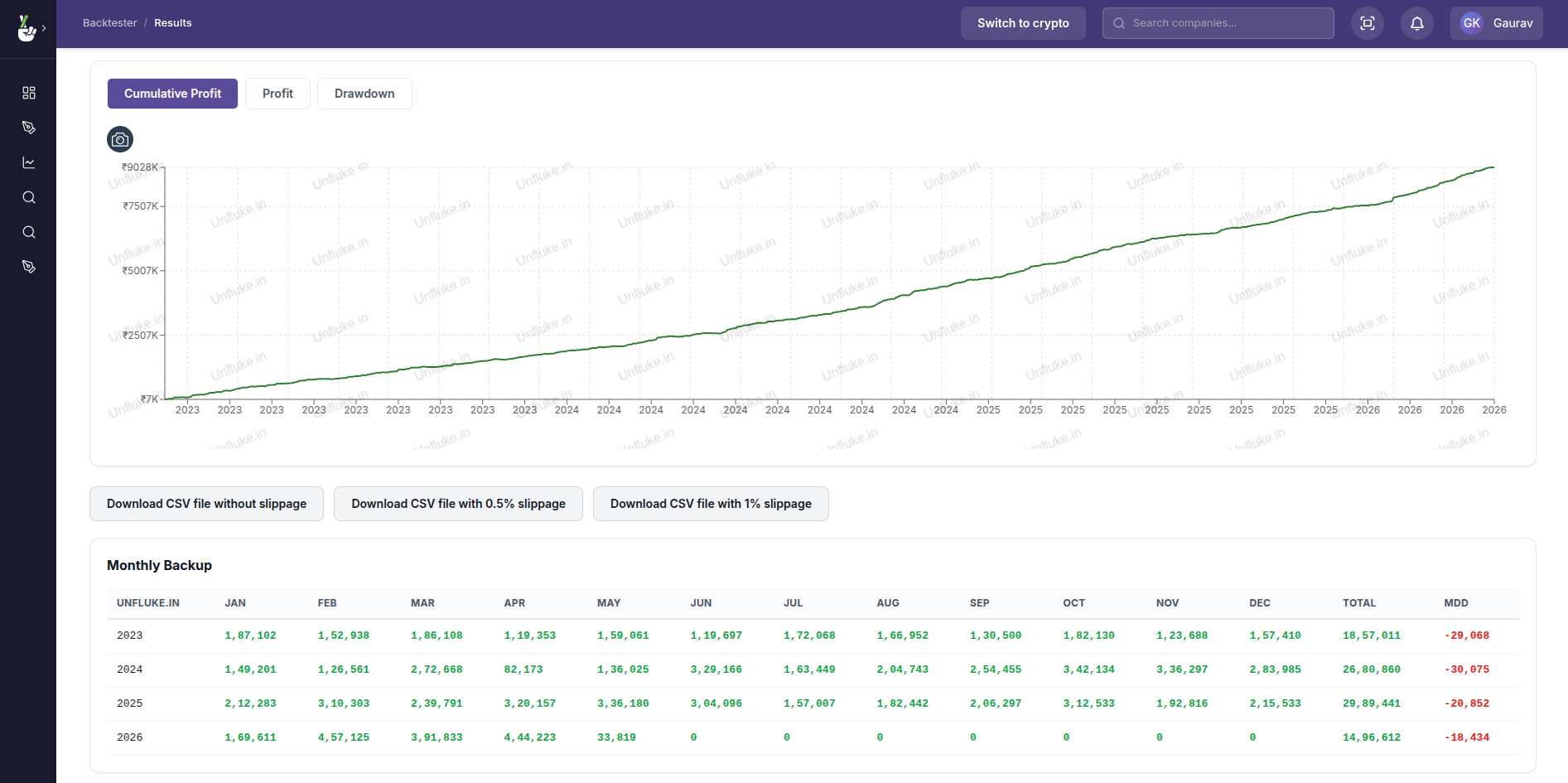
- Equity curve. The shape over time. Smooth uptrend = good. Plateaus and cliffs = harder to trade emotionally.
- Max drawdown. Biggest peak-to-trough loss. If you can't stomach a 35% drawdown before recovery, this strategy isn't for you - regardless of total return.
- Win-rate by itself is misleading. A 30% win-rate strategy can be profitable if avg-win > 3 × avg-loss. Always combine with the next metric.
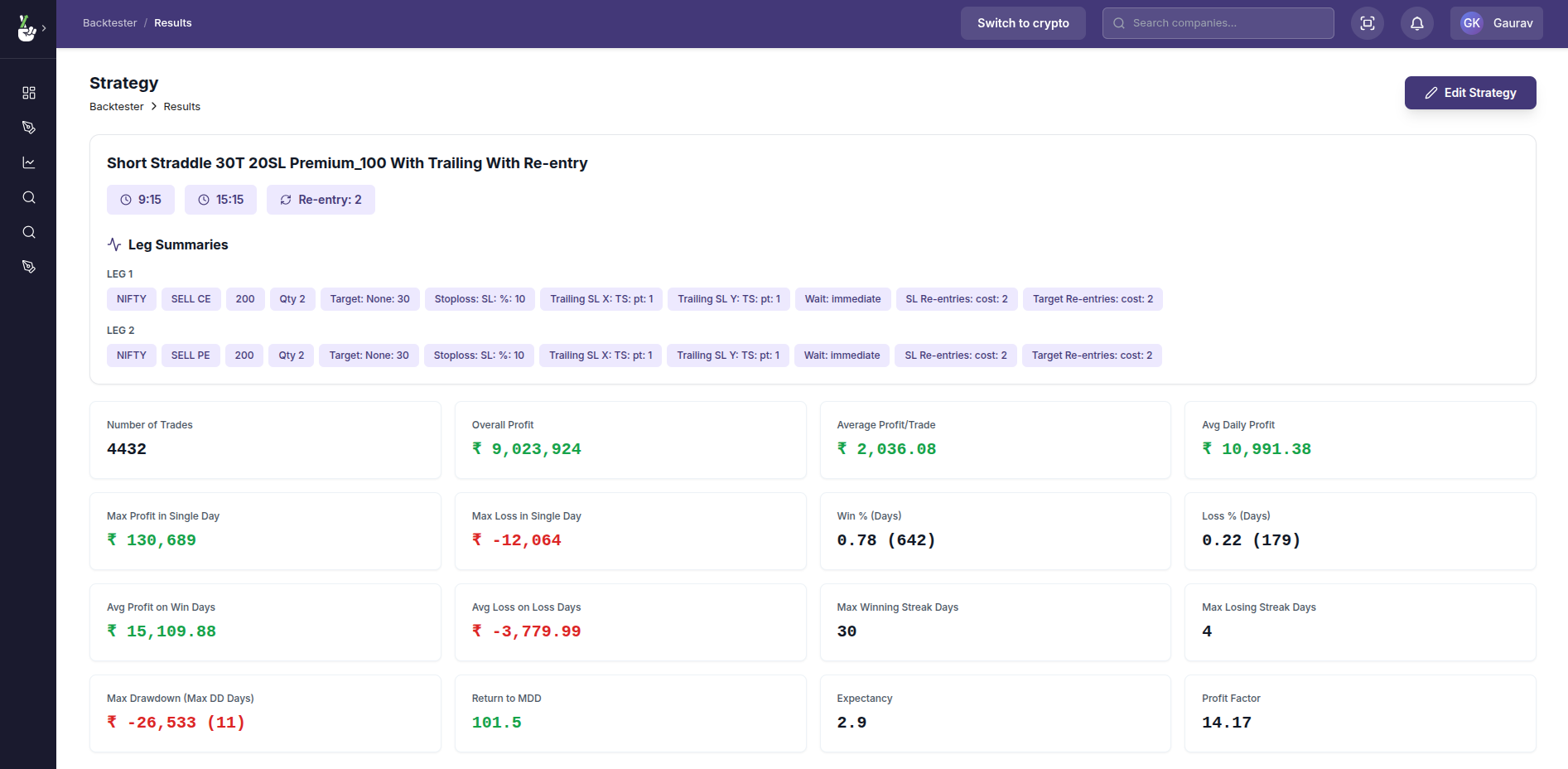
- Profit factor (gross profit / gross loss). Above 1.5 is healthy. Below 1.2 is fragile. Below 1.0 is unprofitable.
- Number of trades. 10 trades over 5 years is a coincidence, not a backtest. 200+ trades is statistically meaningful.
- Sharpe (or daily return std dev). Captures risk-adjusted return. Useful for comparing strategies - not useful in isolation.
No-code, in minutes
You don't need Python or a quant background. Pick an instrument, add entry conditions from a dropdown, set exits and stop-loss, choose a date range, and run. Most users have a first strategy on screen in under 5 minutes. The iteration loop is where speed pays off - a 4-year intraday backtest completes in under 30 seconds, so you can try 20 variants in an hour instead of one.
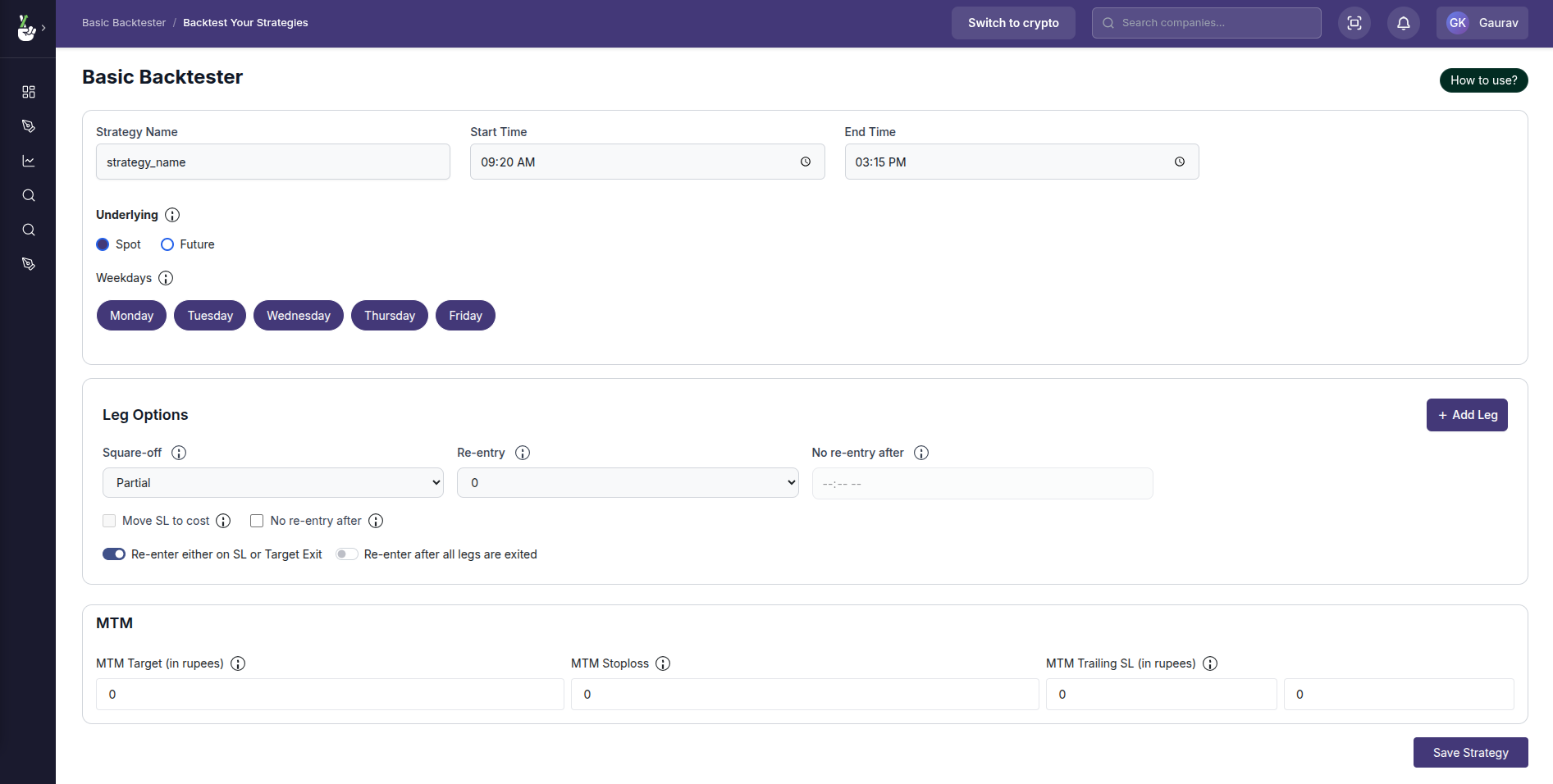
Save strategies to your workspace, share them with the community, or open them in the Strategy Charts view to see every trade plotted on the price.
Walk-forward - the discipline that separates pros
The most uncomfortable backtesting habit is also the most valuable: split your data. Tune parameters only on 2020-22, then test those exact parameters unchanged on 2023-24. If the out-of-sample window survives, you have a candidate strategy. If it doesn't, the in-sample success was over-fitting. Walk- forward ruins most beautiful backtests - which is exactly why it's the right test. Without it, you're not researching, you're curve-fitting.
Common backtesting mistakes
- Over-fitting. Tuning parameters until the equity curve looks perfect on past data. The more you tune, the less your backtest tells you.
- Cherry-picking date ranges. Testing only the window where your strategy worked. Always test across regimes - trending, choppy, crash, recovery.
- Ignoring friction. No STT, no brokerage, no slippage. Overstates returns by 10-30%.
- Look-ahead bias. Using information the strategy couldn't have known at the time. Unfluke guards against this, but custom logic can sneak it in.
- Small sample size. Drawing conclusions from a backtest with 20 trades is statistics theatre.
Strategy ideas (ideas, not promises)
These are ideas to study, paper-trade and backtest, not recommendations or signals, and not a promise of any result. A good backtest shows how a rule behaved in the past; it does not say what it will do next. Size, entries, exits and risk are your own decisions.
1. Start from a baseline
- Setup: backtest a plain rule first, such as a 50/200 EMA trend filter on an index, and save the result.
- Use: every new idea has to beat that baseline on return against max drawdown, not just on total profit.
2. Test one change at a time
- Setup: take a strategy you already trade and change a single input: the stop-loss, the entry time or one indicator setting.
- Reading: if a small change swings the result a lot, the edge is fragile; a robust idea holds up across nearby settings.
3. Compare a naked and a hedged option structure
- Setup: run a short straddle, then the same entry as an iron fly with bought wings, in the Basic Backtester.
- Reading: weigh the lower profit per trade against the smaller max drawdown.
4. Walk it forward
- Setup: tune on one period, then run the unchanged rules on the next period you have not looked at.
- Invalidation: if the out-of-sample result collapses, the first result was fitted to the past.
How to test these
Pick a few past years, run the idea on Unfluke's backtester, and compare the result with a simple baseline before trusting it.
Honest caveats
Backtests are how the past would have rewarded a rule. They are not predictions. We don't model unlimited liquidity or zero-slippage fills - but if your strategy works on illiquid names, that's on you to verify. A clean backtest tells you the strategy is tradeable. Whether you are tradeable - disciplined enough to follow your own rules when 5 losing trades arrive in a row - is a separate question. Past performance does not guarantee future returns.
Where to go next
For a step-by-step worked example, see How to Backtest an Options Trading Strategy. For index-specific deep dives, see Nifty Backtesting or Bank Nifty Backtesting. For platform comparisons, see Best Backtesting Software in India (2026 Guide). Or just sign up free and run your first backtest in under 5 minutes.
More from the blog
- Live Market Scanners
Explore Unfluke's real-time stock scanner for NSE markets. Scan 1,800+ stocks with 40+ technical indicators, fundamental filters, F&O data and custom rules.
- Option Strategy Simulator
Build and simulate multi-leg options strategies with Unfluke. Visualize payoffs, Greeks, max profit and loss, and replay historical option data from 2023.
- Unfluke AI - Your Trading Assistant
Use Unfluke AI as your trading assistant for stock research, scanners, strategy building and backtesting. Ask questions in plain English using Indian market data.