Guide
Options Backtesting Platform - What Actually Matters
12 min read · Updated 2 Nov 2026
Backtesting an equity strategy is a known problem. Backtesting an options strategy is a harder one, and most retail traders don't appreciate why until their live results diverge wildly from their backtest. Options behave non-linearly. Their value moves with spot, time, and volatility. Multi-leg structures interact in ways equity-style backtests cannot capture.
This piece walks through what an options-specific backtesting platform should do - and where most platforms cut corners. By the end you'll know what to demand from any platform you're considering, and you'll see where Unfluke sits in that landscape.
Why options backtesting is fundamentally different
Equity backtests have one moving variable: price. Options backtests have at least four: spot, time-to-expiry, implied volatility, and strike-specific liquidity. The interactions between these drive non-linear P&L. A short straddle that looks fine in a 1% spot move can vaporise in the same percentage move if volatility spikes.
That's why options backtesting needs ticked option chain data - not synthetic prices generated from a Black-Scholes model fed with spot. The actual traded premium at the actual time is the only reliable input.
Multi-leg modelling - the table-stakes requirement
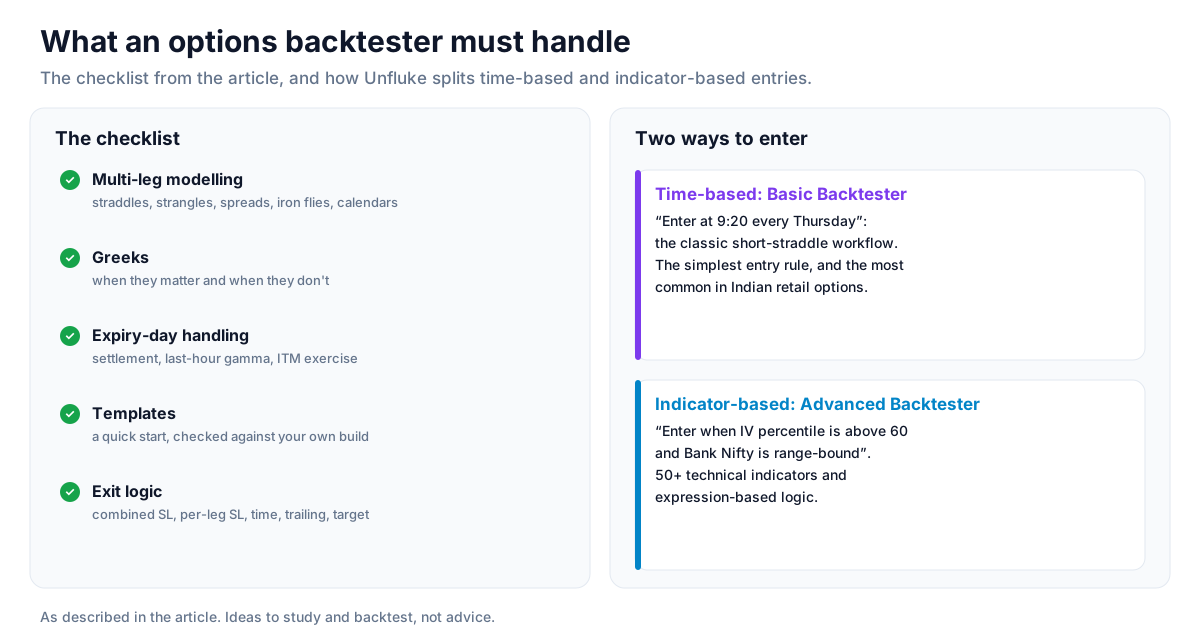
Real options trading is multi-leg. Straddles (sell ATM CE + ATM PE), strangles (sell OTM CE + OTM PE), spreads (buy and sell two strikes), iron flies (4 legs), calendars (2 expiries). A platform that can only backtest single-leg buys or single-leg sells is doing maybe 20% of what real options traders need. Unfluke's Basic Backtester supports up to 4 legs with independent entry, exit, and stop-loss rules per leg, plus combined-SL options.
Greeks - when they matter and when they don't
Greeks (delta, gamma, theta, vega) describe how an option's price responds to changes in the underlying variables. Should your backtester show Greeks? Yes, but with nuance:
- For analysis: Greeks help you understand why your strategy P&L moved. "I lost 30% because gamma went short" is an explanation, not just a number.
- For execution: Greek-aware entry rules ("enter when net delta is within ±10") are powerful but slightly esoteric for most retail traders. Worth having available but not critical.
Unfluke's Option Simulator (separate from the backtester) is the Greeks-focused tool - multi-leg payoff visualisation with live Greeks. The backtester focuses on execution outcomes; the simulator focuses on structural understanding.
Expiry-day handling - the silent backtest killer
Expiry day is when options strategies live or die. A backtester that models expiry-day pricing badly - using the close instead of settlement, ignoring last-hour gamma explosions, or not handling ITM expiry exercise correctly - will give you a fundamentally wrong picture of any expiry-day strategy. Most Indian retail options strategies are expiry-day strategies, so this matters enormously. Demand to see how the platform handles expiry day before you commit.
Pre-built strategy templates - useful or fluff?
Most options backtesting platforms ship with templates: long call, short put, bull call spread, iron condor, calendar. They're useful for getting started - and for double-checking that your custom build of "iron fly" matches the canonical structure. Unfluke ships templates for straddle, strangle, spreads, iron-fly, butterfly, calendar, and double-calendar. Useful starting points; not a replacement for understanding what you're building.
Time-based vs indicator-based entries
Options strategies broadly enter in one of two ways:
- Time-based: "Enter at 9:20 every Thursday" - the classic short-straddle workflow. The simplest entry rule and the most common in retail Indian options.
- Indicator-based: "Enter long iron fly when IV percentile > 60 and Bank Nifty is range-bound" - conditional entries based on technical or volatility signals.
Your platform should support both. Unfluke covers time-based in Basic Backtester and indicator-based in the Advanced Backtester, which adds 50+ technical indicators and expression-based logic.
Exit logic - where most backtests are simplistic
Real options traders exit in complex ways: combined-premium SL, individual-leg SL, time-based exit, trailing SL, target-based exit, IV-based exit, partial book at target. A platform that only supports "exit at X time" is leaving most strategies unmodellable. Unfluke supports combined SL, per-leg SL, time exit, trailing stop, and target-based exits in the Basic Backtester.
Strategy ideas (ideas, not promises)
These are ideas to study, paper-trade and backtest, not recommendations or signals, and not a promise of any result. A platform feature is a research aid, not an edge. Size, entries, exits and risk are your own decisions.
1. Template first, then your own build
- Idea: run a built-in template (straddle, iron fly, calendar) and then your own build of the same structure.
- Reading: if the two differ, your build is not the structure you think it is.
2. Time-based against indicator-based entry
- Idea: run the same structure with a fixed-time entry in the Basic Backtester, then with an indicator condition in the Advanced Backtester.
- Reading: keep the condition only if it improves drawdown or consistency, not just total P&L.
3. Isolate expiry day
Run the strategy with and without holding into expiry day. Much of the risk, and of the modelling error, sits there; seeing it separately tells you whether the edge depends on it.
4. Test the exit, not just the entry
Keep the entry fixed and compare a fixed stop, a time exit and a combined exit. Exits usually change results more than entries.
How to test these
Run each comparison over the same date range with costs on, and compare drawdown and worst day alongside total return.
Honest caveats
Even the best options backtester is modelling. Real execution adds slippage, broker freezes during high IV, fat-finger errors, and emotional deviation. A clean backtest tells you whether the strategy is structurally sound. Whether you can execute it under pressure is a separate skill. Options strategies, particularly short-premium ones, carry the risk of substantial drawdowns. Past performance does not guarantee future returns.
Try Unfluke for options
Run a multi-leg options backtest on real NSE option chain data in under 5 minutes. Sign up free, or read our step-by-step How to Backtest an Options Trading Strategy tutorial.
More from the blog
- Strategy Backtesting on Unfluke
Backtest trading strategies on real Indian market data with Unfluke. Test equity, Nifty, Bank Nifty and options strategies with realistic costs and key metrics.
- Live Market Scanners
Explore Unfluke's real-time stock scanner for NSE markets. Scan 1,800+ stocks with 40+ technical indicators, fundamental filters, F&O data and custom rules.
- Option Strategy Simulator
Build and simulate multi-leg options strategies with Unfluke. Visualize payoffs, Greeks, max profit and loss, and replay historical option data from 2023.