Guide
AI Trading Software - A 2026 Buyer's Guide
13 min read · Updated 2 Nov 2026
"AI trading software" is a category in name only. Under that umbrella sit four very different product types - and most retail traders don't realise they're being sold something they don't need. The category includes legitimate productivity tools, legitimate research assistants, marketing-only signal generators, and everything in between.
This guide breaks the market into four buckets, tells you who each is for, and is honest about which buckets to avoid. It also shows where Unfluke's AI chatbot fits - it's a research and strategy tool, not a signal generator.
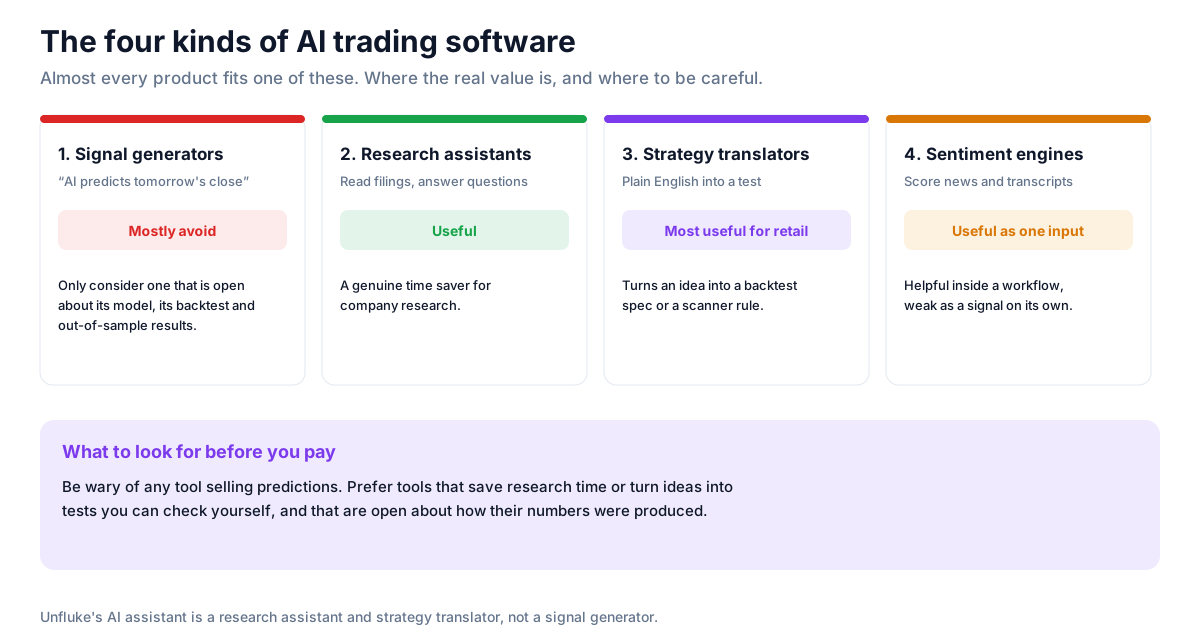
The four buckets of AI trading software
Almost every AI trading product fits into one of these four:
- 1. Signal generators - "AI predicts tomorrow's close". Mostly snake oil. Avoid unless transparent about model, backtest methodology, and out-of-sample performance.
- 2. Research assistants - LLMs that read filings, summarise reports, answer questions about companies. Genuinely useful productivity tools.
- 3. Strategy translators - AI that turns a plain-English strategy description into a backtestable spec or scanner rule. The most useful category for retail traders in 2026.
- 4. Sentiment engines - AI that reads news, earnings transcripts, and social media to score sentiment. Useful as a feature in a broader workflow; less useful as a standalone signal.
Signal generators - why most are snake oil
The marketing claim: "Our AI model predicts price direction with 72% accuracy." The math problem: in efficient-enough markets, persistent prediction accuracy at any scale that matters is vanishingly rare. The marketing problem: most retail AI signal providers report:
- In-sample accuracy (the model was trained on the test data)
- Cherry-picked time windows
- Direction-only accuracy without sizing or P&L
- No track record of out-of-sample performance
How to spot a legitimate signal product: a verifiable out-of-sample track record (3+ years), realistic backtests including slippage and STT, transparent methodology, and no marketing focused on percentage accuracy. The bar is high because the field is full of imposters.
Research assistants - where the real value is
An LLM-based research assistant can:
- Read a 200-page annual report and extract key flags in 30 seconds
- Summarise an earnings call into bullet points
- Compare two companies' financial ratios side by side
- Answer "what's HUL's debt-to-equity ratio?" without you opening Screener
- Draft a fundamental thesis you can then verify
This is where AI is genuinely changing retail trading. Unfluke's Company Fundamentals bot is exactly this - a research compressor for NSE listed companies, available in-app and via Telegram.
Strategy translators - the productivity unlock
The use case: you have an idea, but turning it into a backtestable spec takes 30 minutes of clicking dropdowns. An AI strategy translator lets you describe the strategy in English and gives you back a runnable spec. Examples that work:
- "Test a Bank Nifty short straddle entered Thursday 9:20, exited 3:20, 30% combined SL" → a backtest spec
- "Find midcaps where ROE > 18%, P/E < 25, and RSI(14) crossed above 60 today" → a scanner spec
- "Build a 3-leg iron fly on Nifty with 100-point wings" → an option strategy
Unfluke's chatbot has bot types for Basic Backtest, Advanced Backtest, Scanner, and Fundamental Screener - exactly the strategy-translator category. There's also a YouTube Strategy parser that watches a strategy video and extracts a testable backtest. Slightly gimmicky-sounding until you actually use it.
Sentiment engines - useful, narrowly
Sentiment scoring on news and social media is real and well- studied, but limited for retail use. Sentiment alone is a poor signal - it's noisy and laggy. Where it works: as a confirmation input ("don't trade if sentiment on this name is strongly negative this week"). As a standalone signal generator, it falls into the same bucket as price-prediction AI: usually overpromised.
What to actually buy in 2026
If you're a retail trader, the highest-ROI AI software is:
- Research assistants - they compress hours of report-reading into minutes.
- Strategy translators - they unlock backtest iteration speed.
- Scanner and screener AI - natural language instead of dropdowns.
Skip: price-prediction signal services, "AI bots that trade for you" without a transparent track record, and any product whose marketing leads with accuracy percentages.
Where Unfluke fits
Unfluke's AI chatbot ships six bot types - all in the research-assistant and strategy-translator categories:
- Company Fundamentals - Q&A on NSE listed names
- Fundamental Screener - build screeners from English
- Scanner - build scans from English
- Basic Backtest - option strategies from a sentence
- Advanced Backtest - multi-indicator equity/crypto strategies
- YouTube Strategy - paste a URL, get a backtest
No signal generation. No price prediction. No marketing about accuracy percentages.
Strategy ideas (ideas, not promises)
These are ideas to study, paper-trade and backtest, not recommendations or signals, and not a promise of any result. AI output is a draft for research, never a signal to act on. Size, entries, exits and risk are your own decisions.
1. Draft with AI, verify with a backtest
- Idea: describe a strategy in plain English and let the assistant turn it into rules.
- Check: read the rules it produced, then backtest them yourself before believing any result.
2. Turn a screening idea into a filter
- Idea: ask for a scan in words, then inspect and save the filter it builds in the scanner.
- Invalidation: if the list does not match what you meant, fix the filter by hand rather than rephrasing until it looks right.
3. Use research answers as a starting point
Ask for a company comparison or a summary, then check the key numbers on the fundamentals pages. Treat the answer as a lead to verify, not a conclusion.
4. Test claims you hear elsewhere
When a strategy is promoted online, have the assistant write it as rules and backtest it on Unfluke. Most claims look different once costs and real data are in.
How to test these
Keep a log of what you asked, what the AI produced and what the backtest or the data showed. Over time it shows where the tool saves you time and where it needs checking.
Honest caveats
AI compresses time and surfaces ideas. It doesn't replace judgment. Every AI output - a research summary, a scanner spec, a backtest draft - is a draft, not a decision. Treat it as a faster intern, not as the analyst. No AI software predicts markets reliably.
Try Unfluke's AI chatbot
Free tier includes 5 AI messages a month across all six bot types. Sign up, or read the deeper AI Chatbot overview and the broader AI in Trading piece.
More from the blog
- Strategy Backtesting on Unfluke
Backtest trading strategies on real Indian market data with Unfluke. Test equity, Nifty, Bank Nifty and options strategies with realistic costs and key metrics.
- Live Market Scanners
Explore Unfluke's real-time stock scanner for NSE markets. Scan 1,800+ stocks with 40+ technical indicators, fundamental filters, F&O data and custom rules.
- Option Strategy Simulator
Build and simulate multi-leg options strategies with Unfluke. Visualize payoffs, Greeks, max profit and loss, and replay historical option data from 2023.