Index Focus
Bank Nifty Backtesting - Volatility, Expiry, and What Works
12 min read · Updated 2 Nov 2026
Bank Nifty is the playground for India's most active options traders. Higher volatility than Nifty, deeper weekly option chain, tighter strike intervals, and expiry-day moves that can make or break a month. It's also the index where backtest results diverge most violently from live results if your modelling is sloppy.
This piece walks through Bank Nifty-specific backtesting. Why it's different from Nifty, what archetypes work, what gets killed by expiry-day moves, and the modelling traps that make backtests look better than they really are.
Bank Nifty vs Nifty - why it matters
Bank Nifty is 12 stocks, all banking. Nifty is 50 across sectors. The implications:
- Higher concentration risk. A single bank's quarterly results can move Bank Nifty in ways no single stock can move Nifty.
- Higher beta. Bank Nifty typically moves 1.3-1.6x Nifty intraday. Strategies sized for Nifty volatility get over-leveraged on Bank Nifty.
- Deeper option chain. 100-point strike intervals, weekly expiries, very tight bid-ask on liquid strikes.
- Expiry-day mayhem. The last hour of weekly expiry can move Bank Nifty 200-300 points in minutes. This is where most retail options traders learn position sizing the hard way.
The expiry-day problem
Bank Nifty's biggest retail use case is also its trickiest backtest scenario: weekly expiry strategies. The last hour of expiry has order flow dynamics that are not well represented in 1-minute or 5-minute candles. If your backtester uses simple close prices for fills, you'll see backtest results that cannot be replicated live. Demand to see how your platform handles expiry day before you trust the results. Unfluke uses actual ticked option premiums, which is the most honest input available.
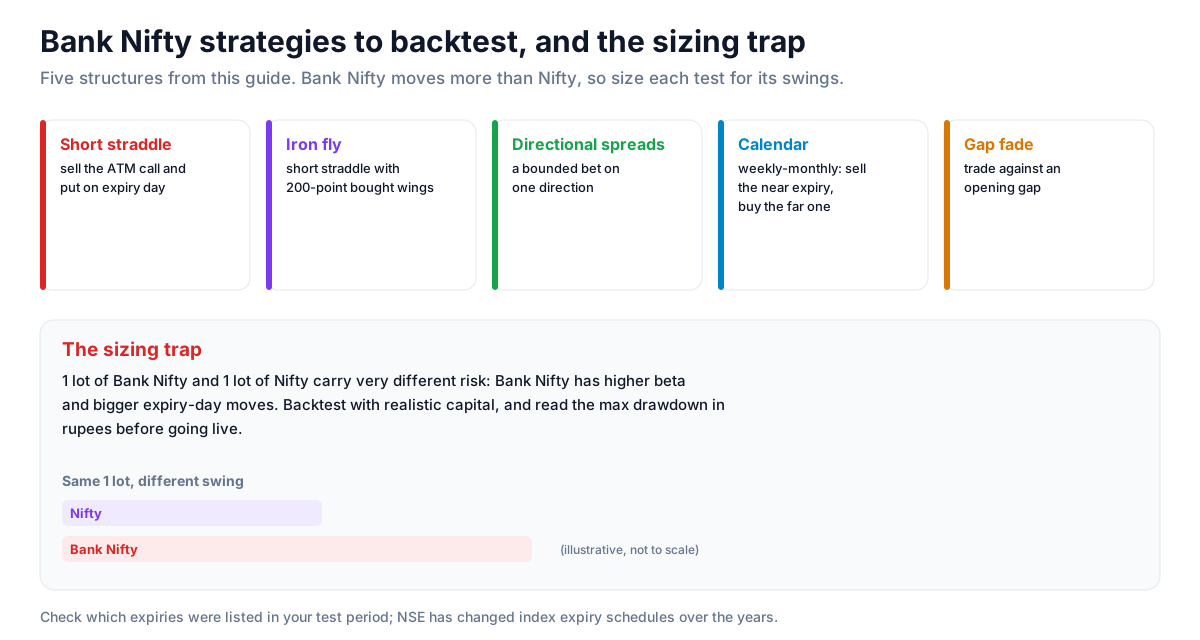
Strategy 1 - Thursday short straddle
Sell ATM CE + ATM PE at 9:20 Thursday, exit 15:20 or combined SL. The retail short-premium classic on Bank Nifty. Higher premium collection per lot than Nifty (because higher IV) - and higher drawdowns during vol spikes. Backtests typically show positive expectancy but with max drawdowns 1.5-2x larger than the same strategy on Nifty.
Strategy 2 - Iron fly with 200-point wings
Sell ATM straddle + buy 200-point OTM wings. Capped risk, lower premium, dramatically lower drawdowns. Most backtests show the iron fly outperforming the naked straddle on risk-adjusted metrics on Bank Nifty even when total return is lower. The asymmetric pay-off of a Bank Nifty IV spike is exactly the scenario that bankrupts naked straddle traders.
Strategy 3 - Directional spreads
Bull call spreads, bear put spreads on a directional view. Less common in retail, but well-suited to Bank Nifty's stronger trends within the day. Useful for traders who have a directional view but want defined risk. Backtests show sensitivity to entry timing - spreads entered after the first hour outperform those entered at open.
Strategy 4 - Weekly-monthly calendar
Sell weekly expiry options + buy monthly expiry options at the same strike. Theta harvest with reduced vega exposure. Sophisticated, less common in retail. Backtests typically show small but consistent positive expectancy in low-vol environments and material losses when realised vol diverges from implied. Not beginner-friendly.
Strategy 5 - Bank Nifty gap fade
On big overnight gaps (more than 0.5%), trade the fade. Backtests show gap fills are more common on Bank Nifty than outright continuations, but the strategy fails dramatically during trending months. Volume confirmation and time-of-day filters meaningfully improve it. Best treated as a tactical overlay, not a standalone system.
Bank Nifty modelling traps
- Slippage on weekly expiry day. Real slippage in the last 30 minutes can be 10-20%. Synthetic backtests assuming zero slippage produce results that don't survive live trading.
- Lot size changes. Bank Nifty lot size has changed historically. Your backtester must apply the correct lot size as of the test date.
- Synthetic option prices. If your platform uses Black-Scholes to estimate option prices from spot, it will systematically misprice Bank Nifty options during high IV. Use ticked data.
- STT impact is brutal. Bank Nifty short premium pays meaningful STT. Backtests without STT modelling dramatically overstate edge.
Position sizing - the Bank Nifty trap
A trader sizing Bank Nifty positions like Nifty positions will blow up. Bank Nifty's higher beta and bigger expiry-day moves mean that "1 lot Nifty" and "1 lot Bank Nifty" represent very different risk. Run your backtests with realistic position sizing - don't assume infinite capital, and respect what "drawdown" means in real money terms before you go live.
Honest caveats
Bank Nifty backtests are powerful but easy to over-trust. Real slippage is worse than modelled. Expiry-day exposure is bigger than the backtest suggests. And position sizing during live trading rarely matches what felt comfortable when reviewing a clean equity curve. Past performance does not guarantee future returns.
Try Bank Nifty backtesting on Unfluke
Real option chain data from 2023, STT and brokerage modelled, up to 4-leg structures. Sign up free. See also Nifty Backtesting for cross-comparison and the step-by-step options tutorial.
More from the blog
- Strategy Backtesting on Unfluke
Backtest trading strategies on real Indian market data with Unfluke. Test equity, Nifty, Bank Nifty and options strategies with realistic costs and key metrics.
- Live Market Scanners
Explore Unfluke's real-time stock scanner for NSE markets. Scan 1,800+ stocks with 40+ technical indicators, fundamental filters, F&O data and custom rules.
- Option Strategy Simulator
Build and simulate multi-leg options strategies with Unfluke. Visualize payoffs, Greeks, max profit and loss, and replay historical option data from 2023.