Index Focus
Nifty Backtesting - Strategies, Data, and What Works
12 min read · Updated 2 Nov 2026
Nifty 50 is the most-traded index in India and one of the cleanest backtesting playgrounds in the world. Clean data from 2023, deep futures, deep weekly options, and enough liquidity that your backtest fills are reasonable approximations of real ones. Whether you're testing a trend-following rule on futures or a short-premium strategy on weekly options, Nifty is where most retail systematic traders cut their teeth.
This piece walks through Nifty backtesting end-to-end. What data you need, how Nifty behaves differently from individual stocks, five popular Nifty strategy archetypes, and what to watch for in your results. Worked examples assume Unfluke as the platform - but the methodology translates.
Why Nifty is a good index to backtest on
- Long, clean history. Daily and minute-level data going back to 2023; deep option chain since 2023.
- Liquidity. Futures and ATM options trade tightly. Slippage is small enough that "filled at close" isn't a wild fantasy.
- Less idiosyncratic noise than single stocks. Nifty is diversified across 50 names, so single-name news doesn't move it much. Cleaner signals for systematic tests.
- Active retail market. Means your strategy will face competition for the same setups - but it also means there's enough activity for short-premium structures to work.
How Nifty backtests differ from stock backtests
Nifty doesn't go to zero. It doesn't have earnings surprises in the same way single stocks do. It mean-reverts less dramatically than midcaps. Its volatility regimes (VIX clusters) are more predictable. The implication: most strategies that work on Nifty don't translate cleanly to single stocks, and most stock-based mean-reversion strategies don't work on Nifty. Treat them as different testing universes.
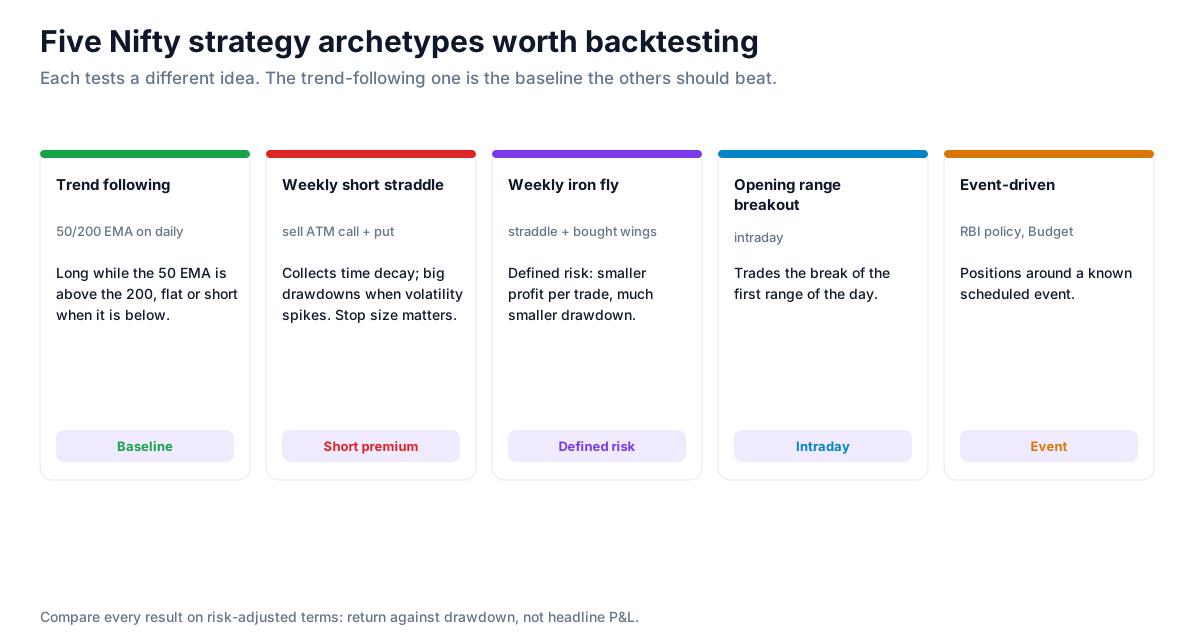
Strategy archetype 1 - Trend following (50/200 EMA)
The simplest possible Nifty strategy: long Nifty futures when 50 EMA > 200 EMA on daily, flat or short when the reverse. Tests back to 2018 show this captures most of Nifty's long uptrend with modest drawdowns during chop. Won't make you rich. Won't blow you up. Excellent baseline to compare your other strategies against - if your fancy setup doesn't beat a 50/200 crossover on risk-adjusted return, it's not a real edge.
Strategy archetype 2 - Weekly short straddle
Sell ATM CE + ATM PE at 9:20 every Thursday (Nifty weekly expiry), exit at 3:20 PM or on combined SL. The classic theta harvest play. Positive expectancy in low-vol regimes, brutal drawdowns when realised vol spikes. Backtests show the sensitivity: stop-loss tightness matters more than entry timing. See our deep dive on options backtesting in our tutorial.
Strategy archetype 3 - Weekly iron fly
A defined-risk version of the short straddle: sell ATM straddle, buy OTM wings. Smaller P&L per trade, dramatically smaller max drawdown. The trade-off is correct: capped losses cost you some expectancy. For traders who don't have the capital to withstand naked-straddle drawdowns, the iron fly backtests better on risk-adjusted metrics even if the headline return is lower.
Strategy archetype 4 - Opening range breakout
On Nifty futures: define the high and low of the first 15 minutes, then trade breakouts of that range for the rest of the day. Backtests show mixed results - works in trending months, gets chopped to pieces in range-bound months. The volume confirmation filter ("breakout only if next-bar volume > 1.5x previous bar") materially improves it. Worth backtesting on Bank Nifty side by side to see how it generalises.
Strategy archetype 5 - Event-driven (RBI policy, budget)
Trade Nifty options around scheduled high-impact events. Backtests typically show that pre-event IV is rich (you're selling fear) and post-event the realised move is often smaller than implied. Short-premium structures around events have positive expectancy on average - but the tail risk (a genuinely surprising event) makes risk management critical. Iron flies usually backtest better than naked straddles for event plays.
Nifty-specific data quirks to watch
- Special trading days. Muhurat trading, Diwali sessions, half-days. Strip these from your backtest or treat them separately.
- Weekly expiry weekday change. NSE has shifted Nifty's expiry weekday in the past. A backtest that assumes a single weekday throughout is wrong on historical dates.
- Pre-open session. 9:00-9:08 AM is the pre-open auction. Don't backtest on this data.
- Index reconstitution. When NSE changes Nifty constituents, the daily continuity is preserved for index level, but individual stock components shift. Less relevant for index-level strategies; matters for relative-value setups.
Interpreting Nifty backtest results
Two patterns to watch for. (1) Strategies that look great in 2020-21 (high vol, lots of moves) and fall apart in 2022-24 (range-bound, lower vol). That's regime sensitivity - not a disqualification, but you need to know it. (2) Strategies that look great in 2022-24 (chop) and untested in trending markets. Test across regimes deliberately.
Honest caveats
Nifty backtests are cleaner than single-stock backtests, but they're still backtests. Real fills are worse than simulated ones, particularly on options at the open and close. Strategies with positive expectancy on paper can have crushing real-world drawdowns. Walk-forward test everything. Past performance does not guarantee future returns.
Try Nifty backtesting on Unfluke
Sign up free and run your first Nifty backtest in under 5 minutes. For Bank Nifty-specific testing, see Bank Nifty Backtesting. For options specifically, see our step-by-step options backtesting tutorial.
More from the blog
- Strategy Backtesting on Unfluke
Backtest trading strategies on real Indian market data with Unfluke. Test equity, Nifty, Bank Nifty and options strategies with realistic costs and key metrics.
- Live Market Scanners
Explore Unfluke's real-time stock scanner for NSE markets. Scan 1,800+ stocks with 40+ technical indicators, fundamental filters, F&O data and custom rules.
- Option Strategy Simulator
Build and simulate multi-leg options strategies with Unfluke. Visualize payoffs, Greeks, max profit and loss, and replay historical option data from 2023.