Guide
Best Backtesting Software India - What to Look For
11 min read · Updated 2 Nov 2026
Picking backtesting software for Indian markets is harder than for most other countries, and the reason is friction. NSE has its own tax structure (STT, stamp duty, exchange transaction charges), its own lot sizes for F&O, weekly expiry quirks, and a depth of options data that few foreign-built tools handle correctly.
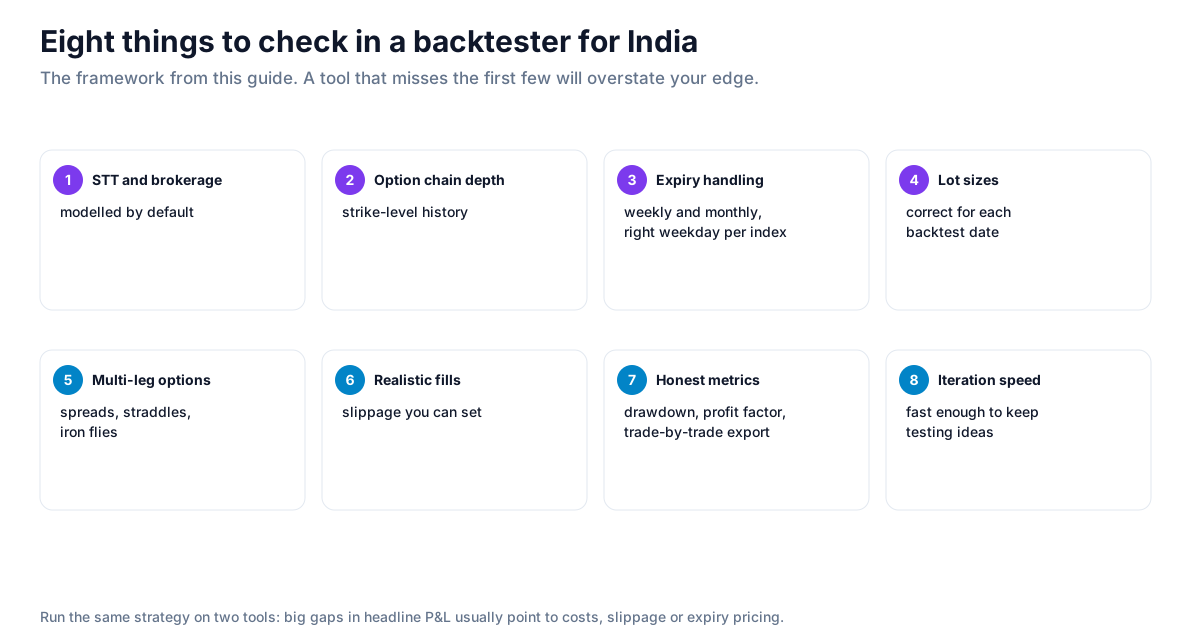
This guide doesn't recommend a single platform. Instead, it gives you a framework - the seven Indian-market-specific criteria your backtesting software needs to handle properly. Walk through this before you commit to anything, including Unfluke.
1. STT and brokerage modelling - non-negotiable
Securities Transaction Tax on options is brutal: 0.05% on premium for option buyers' exits, 0.0625% on options sold (on the sell side at intrinsic value if exercised). For a trader selling 100 straddles a month at 200-point premiums on Bank Nifty, the STT bill is non-trivial. Stamp duty, GST on brokerage, and exchange transaction charges stack on top.
A backtest that ignores any of this overstates your edge by 10-30%. If the platform doesn't let you configure STT, brokerage, slippage, and stamp duty - and apply them per trade - it's not built for Indian markets. Unfluke models all of these by default, with configurable rates if you have a non-standard broker plan.
2. Option chain depth - strike level, 2023+
Indian options data is uniquely demanding because of the weekly expiry cycle and the strike density on Bank Nifty and Nifty. Foreign-built tools that price options synthetically (using Black-Scholes from spot) miss the actual ticked premiums by wide margins on volatility-rich days. Real option chain data, tick by tick, strike by strike, back to at least 2023, is what separates a serious Indian options backtester from a wrapper. Unfluke has this in its core data layer.
3. Weekly + monthly expiry handling
Nifty, Bank Nifty, FinNifty, and MidCap Nifty all have weekly expiries on different weekdays. A backtester that defaults to monthly expiry - or worse, treats Tuesday and Thursday expiries as the same - produces results that don't match what a live trader would have seen. Your platform must let you pick "weekly expiry on the appropriate weekday" without manual hacks.
4. Correct lot sizes and contract specifications
Bank Nifty lot size has changed multiple times. F&O contract specs change. A platform that hard-codes a lot size from 2020 is wrong today. The backtester should pick the correct lot size as of the historical date being simulated - otherwise your P&L is wrong on a per-trade basis, not just in aggregate.
5. Multi-leg options support
Most Indian options retail trading is multi-leg: straddles, strangles, spreads, iron flies, calendars. A backtester that only lets you backtest single-leg options strategies covers maybe 20% of real-world retail use. The platform should let you define 2, 3, or 4-leg strategies with independent strike selection and independent exit rules per leg - or coordinated combined SL. Unfluke's Basic Backtester handles this natively.
6. Realistic fill modelling
"Filled at close" is rarely how real trading works. A serious backtester models slippage - at minimum, by allowing you to set a percentage slippage per trade, and ideally by using bid/ask spread data where available. On Bank Nifty weekly options, real slippage in volatile periods can be 5-10%. A platform that assumes zero slippage gives you a fictional equity curve.
7. Honest, complete metrics
The headline P&L means almost nothing. A real backtester shows:
- Equity curve
- Max drawdown (absolute and percentage)
- Win-rate
- Average win / average loss
- Profit factor (gross profit / gross loss)
- Sharpe ratio (or at least daily return std deviation)
- Trade-by-trade log, downloadable as CSV
If you can't see all of these, you can't assess the strategy.
8. Iteration speed
How many backtests can you run in an hour? If the answer is fewer than 20, your research velocity will stall. A modern backtester for Indian markets runs a 4-year intraday backtest in under 30 seconds. If yours doesn't, you'll stop iterating, and you'll settle on the first plausible strategy instead of finding the best one.
How Unfluke measures against this framework
- STT & brokerage modelling: Yes, default on, configurable
- Option chain depth: Strike-level, 2023+
- Expiry handling: Weekly + monthly, correct weekday per index
- Lot sizes: Historically accurate per backtest date
- Multi-leg: Yes, up to 4 legs in Basic Backtester
- Slippage: Configurable percentage
- Metrics: All of the above, plus trade-by-trade CSV export
- Speed: Most 4-year backtests complete in under 30 seconds
Strategy ideas (ideas, not promises)
These are ideas to study, paper-trade and backtest, not recommendations or signals, and not a promise of any result. A backtester that passes every check still only shows the past. Size, entries, exits and risk are your own decisions.
1. Run a cost check
- Setup: backtest an options strategy with STT and brokerage on, then off.
- Reading: the gap shows how much a tool that ignores costs would overstate the edge.
2. Check expiry and lot size handling
- Setup: run a weekly options strategy across a period when lot sizes or expiry days changed.
- Reading: trades should use the lot size and expiry that applied on each date.
3. Compare two tools on one strategy
- Setup: run the same short straddle on two backtesters.
- Reading: large differences usually point to costs, slippage or expiry-day pricing.
How to test these
Use the eight criteria as a checklist while you run the same strategy on Unfluke and on any tool you are comparing.
Honest caveats
No backtester is perfect. Even with realistic STT, slippage, expiry, and lot-size handling, real-world trading adds variables - emotional discipline, execution latency, broker freezes during volatility, and your own mistakes. A backtest is necessary but not sufficient for profitable trading. Past performance does not guarantee future returns.
Test your framework against Unfluke
Walk through this checklist on any backtester you're considering. Then try Unfluke free and verify our claims with your own strategy. For a side-by-side comparison of six platforms, see Best Backtesting Software in India for Traders (2026 Guide).
More from the blog
- Strategy Backtesting on Unfluke
Backtest trading strategies on real Indian market data with Unfluke. Test equity, Nifty, Bank Nifty and options strategies with realistic costs and key metrics.
- Live Market Scanners
Explore Unfluke's real-time stock scanner for NSE markets. Scan 1,800+ stocks with 40+ technical indicators, fundamental filters, F&O data and custom rules.
- Option Strategy Simulator
Build and simulate multi-leg options strategies with Unfluke. Visualize payoffs, Greeks, max profit and loss, and replay historical option data from 2023.