Guide
Best Backtesting Software in India for Traders (2026 Guide)
14 min read · Updated 2 Nov 2026
If you trade Indian markets in 2026, intuition is no longer an edge. Discipline and data are. Backtesting software is how you turn a hunch into a hypothesis and find out - before risking a single rupee - whether your idea would have survived the last decade of Nifty, Bank Nifty, and equity price action.
But not every backtester is built for the Indian market. NSE has its own expiry quirks, STT structure, lot sizes, and option chain depth. Most foreign-built tools handle these poorly or not at all. This guide compares six platforms Indian traders actually use in 2026 - what each gets right, what it misses, and which fits your style.
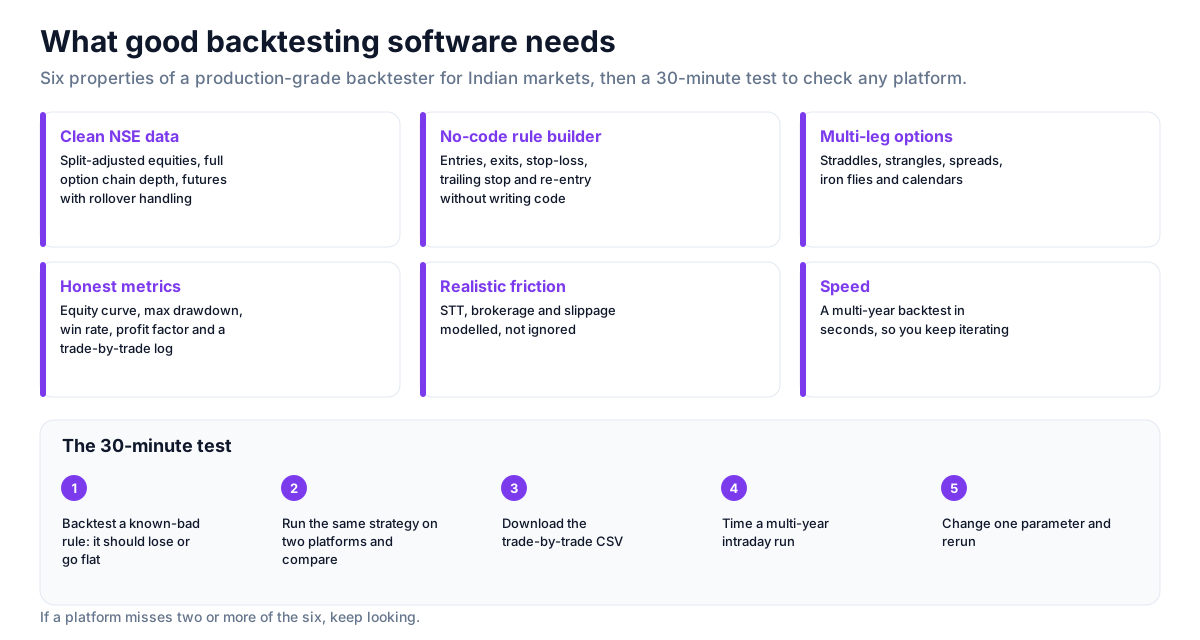
What "good" backtesting software looks like in 2026
Before comparing platforms, define what you're buying. A production-grade backtester for Indian markets has six properties. If your shortlist platform misses two or more, keep shopping.
- Clean, point-in-time NSE data - split-adjusted equities, full option chain depth (every strike, every expiry, every minute), and futures with rollover handling.
- No-code rule builder - most retail traders don't write Python. A dropdown-based builder for entries, exits, stop-loss, trailing stop, and re-entry is non-negotiable.
- Multi-leg options support - straddles, strangles, spreads, iron flies, calendars. Anything less and you can't model the strategies most NSE options traders run.
- Honest metrics - P&L curve, max drawdown, win-rate, profit factor, Sharpe, and a downloadable trade-by-trade log. Not just a vanity total return.
- Realistic friction - STT, brokerage, slippage modelling. A backtest that ignores STT on options will overstate your edge by 10-30%.
- Speed - a 10-year backtest should run in seconds, not minutes. Otherwise you'll stop iterating.
Now we can rank.
The six platforms Indian traders use in 2026
Below is the short-list. None of these are bad products - but they're built for different traders. Pick by use case, not brand.
| Platform | Best for | Indian-market data | Multi-leg options | No-code | Free tier |
|---|---|---|---|---|---|
| Unfluke | End-to-end retail toolkit | NSE eq + F&O + indices, 2023+ option chain | Yes | Yes | Yes |
| Streak | Broker-tied scanning + backtest | NSE equity + indices | Limited | Yes | Trial only |
| AlgoTest | Options backtesting depth | NSE options, deep | Yes | Yes | Limited |
| Tradetron | Live algo deployment | NSE + crypto via brokers | Yes | Yes | Limited |
| TradingView Strategy Tester | Charting-first analysts | Global incl. NSE eq | No | Pine Script required | Yes |
| Amibroker | Power users, AFL programmers | Whatever data feed you buy | Limited | AFL required | Paid only |
Streak, AlgoTest, Tradetron - the broker-tied trio
Streak (Zerodha-owned) is the default for most retail Indian traders. It's clean, fast, and bundled with Kite. The limitations show up at the edges: option strategies beyond simple buy/sell are awkward, and you can't backtest indicator stacks more than a couple of layers deep without running into UI walls.
AlgoTest went deep on options backtesting earlier than anyone else and it shows. Strike-level depth, expiry handling, and Greek-aware exits are all solid. The trade-off: it's specialised - equity backtests are an afterthought, and the UI assumes you already know what an iron fly is.
Tradetron is the closest the Indian market has to "QuantConnect lite". It's powerful for live algo deployment across brokers, but the backtesting experience is more "verify before you deploy" than "explore an idea". Casual research is painful.
If you're a Zerodha user who runs simple rules, Streak is fine. If your edge is purely in options, AlgoTest. If you intend to deploy live algos and want one platform for backtest + execution, Tradetron.
TradingView Strategy Tester and Amibroker - the generalists
TradingView's Strategy Tester is the most-used backtester in the world, but it's not built for Indian options. You'll backtest equity strategies in Pine Script just fine - but multi-leg option strategies, NSE-specific friction, and full option chain data aren't part of the package. Great for charting, limited for serious NSE research.
Amibroker remains the choice for Indian quants who grew up writing AFL. The engine is fast, the customisation is total, and if you have a paid data feed (Global Datafeeds, TrueData), you can model just about anything. But the learning curve is brutal and the UI hasn't materially evolved in 15 years. If you don't already know AFL, the time cost of getting productive is months, not days.
Verdict: TradingView for charting-first analysts. Amibroker for power users who've already invested in the ecosystem.
Where Unfluke fits - and where it doesn't
Unfluke is built for the trader who wants one place to research, backtest, scan, paper-trade, and learn - without writing code, and without juggling four subscriptions. The two backtesters work in tandem: Basic Backtester handles time and indicator-driven rules including multi-leg options; Advanced Backtester adds expression-based logic over 50+ indicators with cross-above / cross-below triggers and multi-timeframe support.
The data layer is what we obsess over: option chain back to 2023 with full strike depth, equity data going back to 2023 split-adjusted, and indices to 2023. STT and brokerage are modelled in every backtest.
Where Unfluke is not the right fit: if you already write C++ or Python strategies and need raw tick data with custom event loops, you'll find our no-code builder limiting. We're built for the 95% of retail traders who want clarity, not the 5% running proprietary engines.
The free tier on Unfluke lets you backtest with every feature on the last 3 months of data - plan tiers (Free, Advanced, Pro) gate how far back your data goes and the volume of backtests, alerts, and AI bot messages per month, not the data quality.
How to evaluate a backtester in 30 minutes
Don't believe the demo video. Run a deliberate test on any platform you're considering. Here's a 30-minute checklist:
- Take a known-bad strategy (e.g. "buy on RSI > 70, sell on RSI < 30") and backtest it on Nifty over 2018-2024. The platform should show a losing or flat curve. If it shows outsized returns, the data or modelling is off.
- Backtest a Bank Nifty short straddle on weekly expiry from Jan 2023. Compare your headline P&L against the same strategy on another platform. Differences >15% point to modelling issues (STT, slippage, expiry-day pricing).
- Check trade-by-trade output. Can you download a CSV? Does it include entry/exit timestamp, instrument, quantity, P&L? If not, you can't debug your strategy.
- Time the backtest. A 4-year intraday backtest that takes 90+ seconds is too slow - you won't iterate.
- Try editing the strategy and rerunning. If tweaking one parameter feels like a UI scavenger hunt, your research velocity will drop to zero in production use.
Strategy ideas (ideas, not promises)
These are ideas to study, paper-trade and backtest, not recommendations or signals, and not a promise of any result. Picking a tool is a research decision; no platform makes a strategy profitable. Size, entries, exits and risk are your own decisions.
1. Run a known-bad strategy first
- Idea: backtest a strategy you expect to lose (the RSI example above) on every platform you are considering.
- Reading: a tool that shows strong profits for it has a data or modelling problem.
2. Same strategy, two platforms
- Idea: run one simple options strategy, such as a weekly short straddle, on two tools over the same dates.
- Reading: a large gap in headline P&L usually comes from costs, slippage or expiry-day pricing; find which before trusting either.
3. Costs on, then off
Run the same backtest with costs included and excluded. If the edge disappears once STT, brokerage and slippage are in, the strategy was never tradable.
4. Measure your iteration speed
Change one parameter and rerun. The tool you will actually use is the one where that takes seconds, because research is many small reruns.
How to test these
Spend the 30 minutes from the checklist above on each shortlisted platform with the same two strategies, and keep the trade-by-trade files so you can compare them line by line.
Honest caveats - backtests aren't predictions
Even the best backtesting software answers one question: how would this rule have done in the past? It can't answer "will it work next quarter". Regime changes, structural shifts in volatility, and unmodelled slippage in illiquid names all bend real returns below backtested ones - sometimes catastrophically.
Treat a backtest as evidence, not proof. A strategy that's profitable on 10 years of data and on 3 separate market regimes (2017-19 trend, 2020 crash, 2022-24 chop) is interesting. One that's only profitable on a narrow slice is data-mined. Run walk-forward tests. Don't over-fit to a single backtest result.
Past performance does not guarantee future returns.
FAQ
Is Unfluke free?
Yes - the Free tier lets you backtest with every feature on the last 3 months of data. Paid tiers add more history and higher monthly backtest, alert, and AI message quotas. See /pricings.
Does Unfluke support Bank Nifty backtesting?
Yes - Bank Nifty equity, futures, and options including weekly expiries are all supported. See our dedicated Bank Nifty backtesting guide.
Can I backtest crypto strategies?
Yes - Unfluke supports backtesting on the top 20 crypto pairs.
What about Pine Script or Python?
Unfluke is no-code by design. If you need scriptable strategy definitions, TradingView (Pine) and Amibroker (AFL) remain better fits.
How far back does the option chain go?
Full strike-level depth from 2023 onwards.
Try it yourself
The fastest way to decide is to run your own strategy on real data. Sign up free and have a Nifty or Bank Nifty backtest on screen in under five minutes. If you'd rather see how the engine works first, read our Strategy Backtesting overview or our step-by-step How to Backtest an Options Trading Strategy tutorial.
More from the blog
- Strategy Backtesting on Unfluke
Backtest trading strategies on real Indian market data with Unfluke. Test equity, Nifty, Bank Nifty and options strategies with realistic costs and key metrics.
- Live Market Scanners
Explore Unfluke's real-time stock scanner for NSE markets. Scan 1,800+ stocks with 40+ technical indicators, fundamental filters, F&O data and custom rules.
- Option Strategy Simulator
Build and simulate multi-leg options strategies with Unfluke. Visualize payoffs, Greeks, max profit and loss, and replay historical option data from 2023.