Market Terminal
NSE Holidays 2026: How to Read the Trading Calendar
8 min read · Updated 2 Nov 2026
The Trading Calendar shows the days NSE is closed for trading in any year from 2020, on a 12-month grid and in a trading holidays list.
This guide explains how to read the page and why holiday weeks and long weekends are worth planning around.
What is the NSE trading calendar?
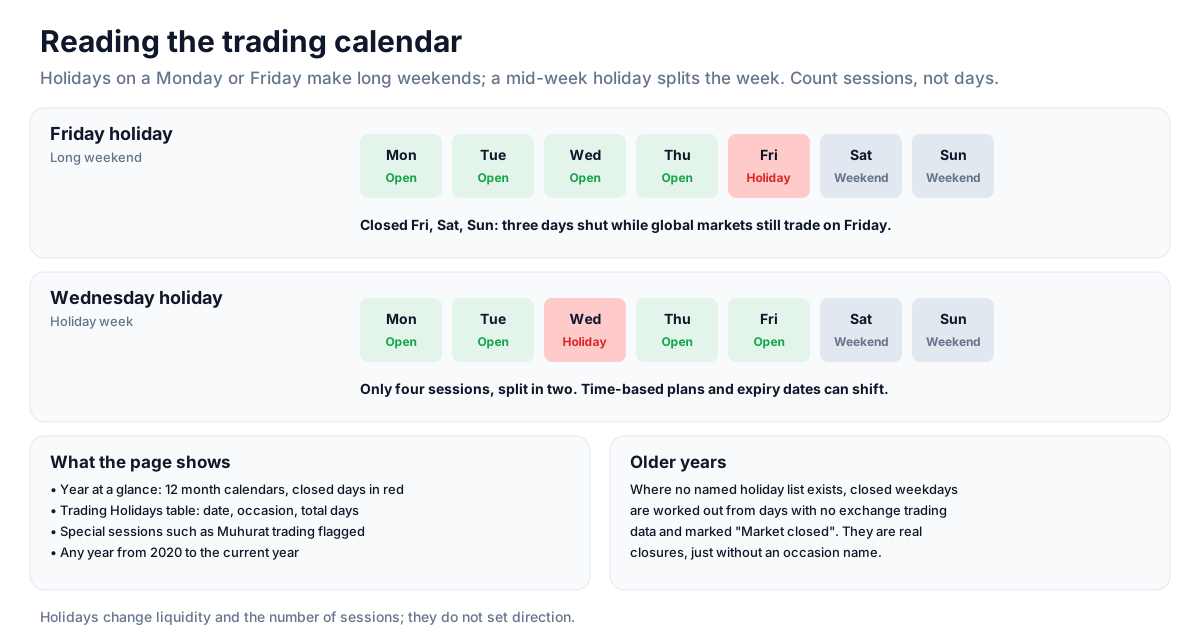
Besides weekends, the exchange closes on a set of public and religious holidays each year. The trading holidays list tells you which weekdays have no trading session.
For years where NSE has published a named holiday list, Unfluke shows each holiday with its occasion. For earlier years without a named list, the page shows the real closed weekdays worked out from days with no exchange trading data, marked "Market closed" without an occasion name.
How to read it
- Year selector - choose any year from 2020 to the current year.
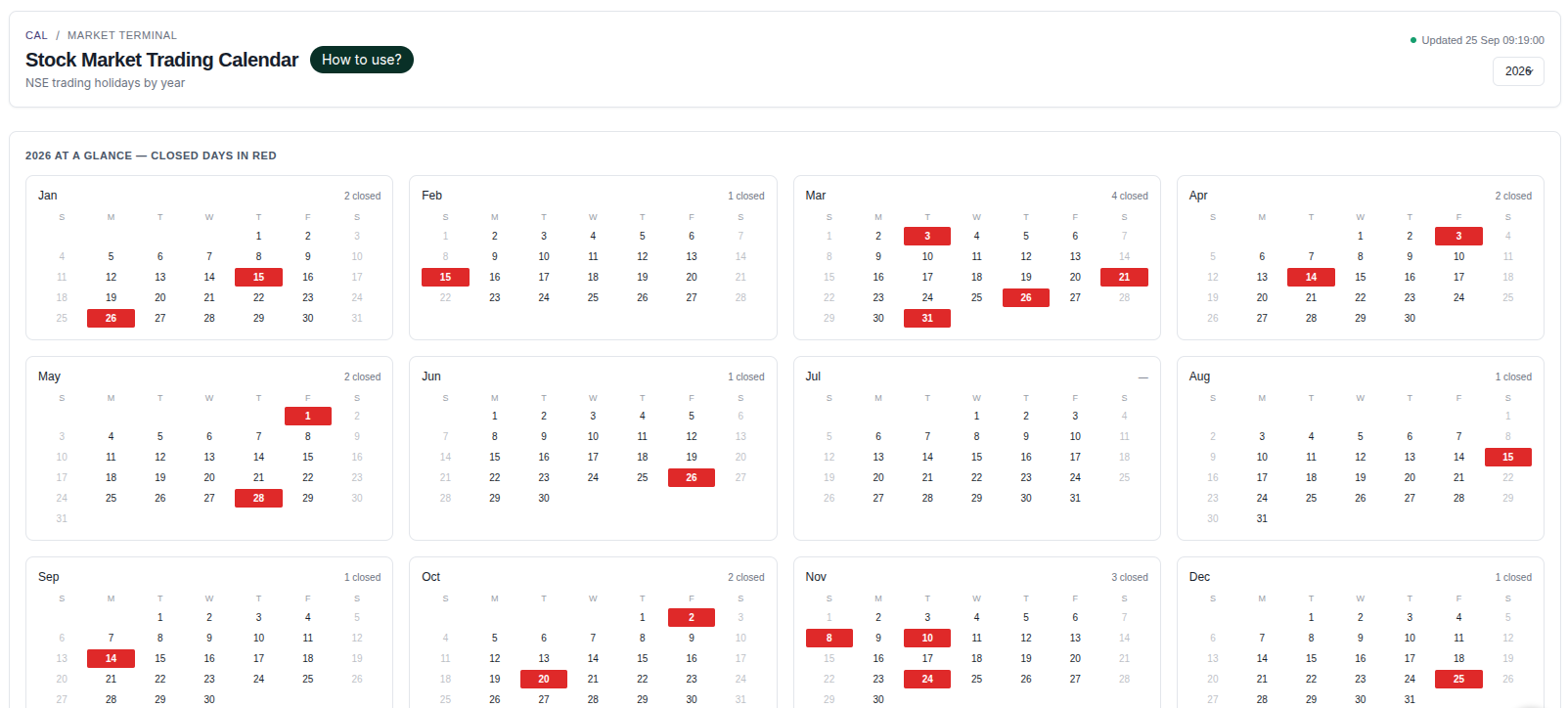
- Year at a glance - twelve small month calendars; closed days are shown in red. Hover a red day to see the occasion.
- Trading Holidays table - every holiday in the year with its date and occasion, and the total number of days. Special sessions such as Muhurat trading are flagged next to the holiday.
- Notice - for years without a named list, a note explains that the dates are derived from exchange data.
Using the page for research
- Check the grid for holidays that fall on a Monday or Friday - these create long weekends.
- Look for weeks with a mid-week holiday, which have fewer trading sessions than usual.
- Compare years to see how the number and timing of holidays changes.
- Keep the list in mind when counting trading days for any time-based analysis, such as a number of sessions to a date.
Holiday weeks and long weekends
Sessions just before a holiday, and especially before a long weekend, often see lighter participation. Lower volume can mean wider spreads and moves that look larger than they would in a normal session.
A market closure also means news from the rest of the world keeps arriving while Indian markets cannot react, which can show up as a gap when trading resumes. For derivatives traders, it is general market knowledge that holidays can shift contract expiry dates and reduce the number of sessions in an expiry week.
Strategy ideas (ideas, not promises)
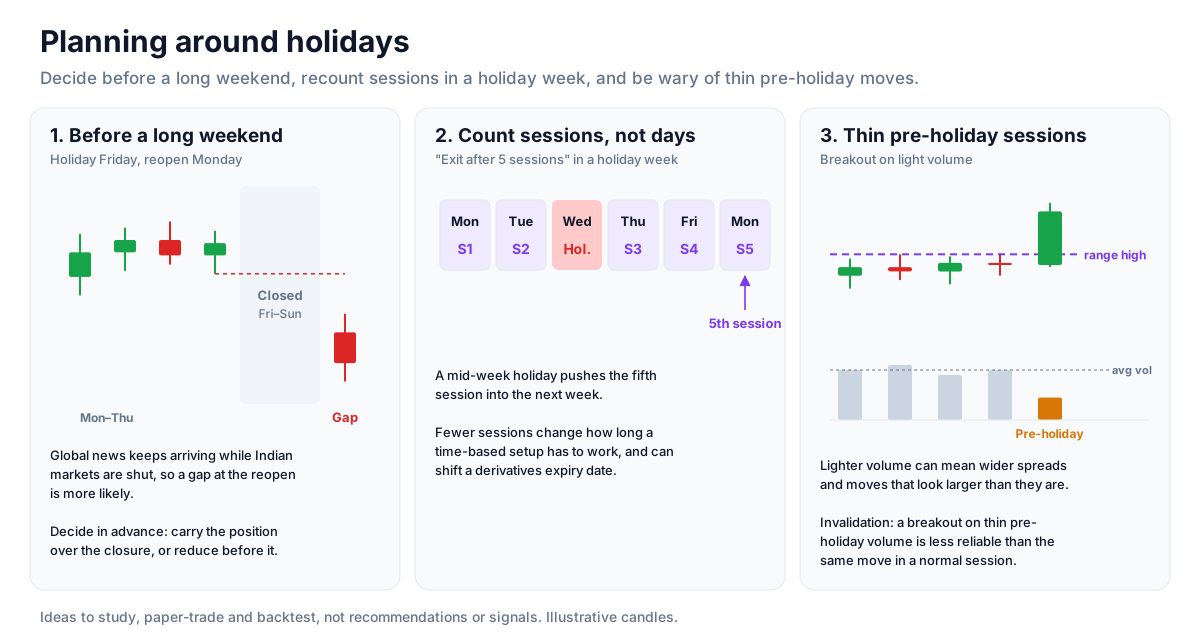
These are ideas to study, paper-trade and backtest, not recommendations or signals, and not a promise of any result. Holidays change liquidity and gaps; they do not set direction. Size, entries, exits and risk are your own decisions.
1. Reduce exposure before long weekends
- Setup: a holiday on a Monday or Friday on the Trading Calendar.
- Reading: global news keeps arriving while Indian markets are shut, so a gap at the reopen is more likely.
- Use: decide in advance whether a position should be carried over the closure or reduced before it.
2. Recount sessions in a holiday week
- Setup: a week with a mid-week holiday.
- Reading: fewer sessions change how many days a time-based setup has to work, and can shift a derivatives expiry date.
- Use: count trading sessions, not calendar days, for any exit or expiry plan.
3. Expect thinner pre-holiday sessions
- Reading: lighter volume before a holiday can mean wider spreads and moves that look larger than they are.
- Invalidation: breakouts on thin pre-holiday volume are less reliable than the same move in a normal session.
How to test these
Use the Trading Calendar to find past long weekends, then check on the Historical Charts how often the reopening session gapped and how large the gaps were compared with ordinary Mondays.
Where to go next
Return to the reference data guide or read PCR trend analysis for derivatives context. Try the Trading Calendar free.
How to Read This Data
The trading calendar lists exchange holidays, special sessions and expiry dates. It is a practical reference for knowing when markets are open and how holidays can shift expiry days.
- Check which days the exchange is closed in a given month or year.
- Note when a holiday moves an expiry to an earlier day.
- Look for special sessions such as Muhurat trading and their shorter timings.
- Compare years to see how the number of trading days changes.
Limitations: Exchanges can add or change holidays by circular. Confirm dates with the official exchange calendar.
More from the blog
- Strategy Backtesting on Unfluke
Backtest trading strategies on real Indian market data with Unfluke. Test equity, Nifty, Bank Nifty and options strategies with realistic costs and key metrics.
- Live Market Scanners
Explore Unfluke's real-time stock scanner for NSE markets. Scan 1,800+ stocks with 40+ technical indicators, fundamental filters, F&O data and custom rules.
- Option Strategy Simulator
Build and simulate multi-leg options strategies with Unfluke. Visualize payoffs, Greeks, max profit and loss, and replay historical option data from 2023.