Stock Market Basics
Demat, Trading and Bank Accounts: How Are They Different?
7 min read · Updated 2 Nov 2026
Buying shares in India takes a bank account, a trading account and a demat account, all working together. Since they usually get opened at the same time, it's easy to mix them up.
So which one does what? Here's how each account works and how they link up.
The bank account is where your money lives
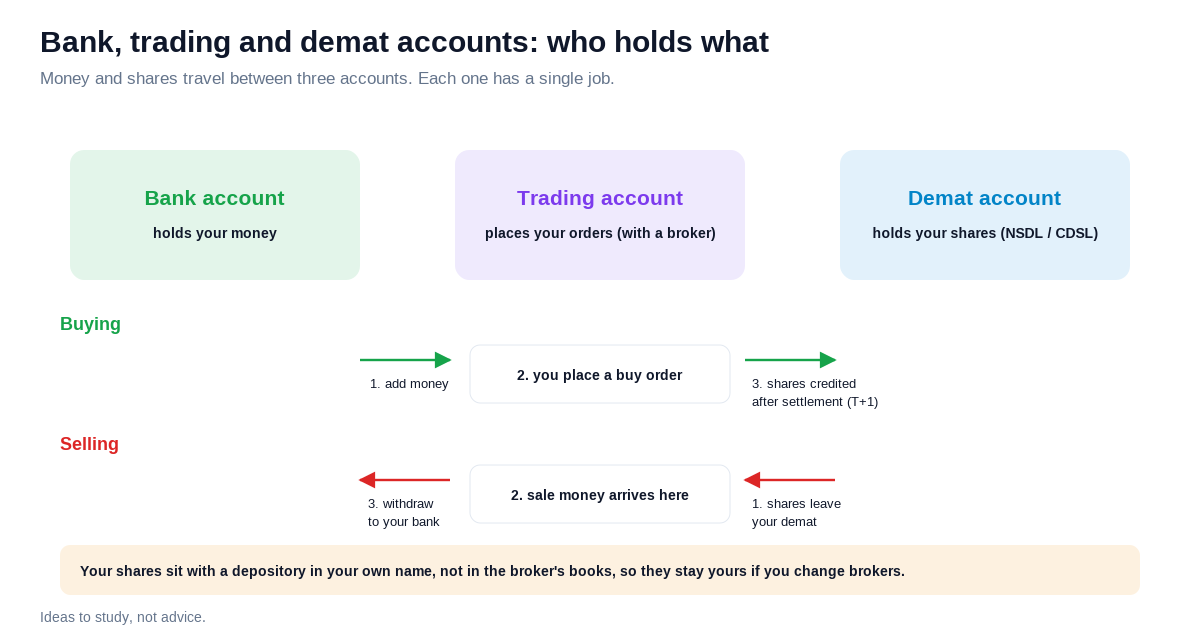
Your cash sits in your bank account. Before you buy, you move money from it to your broker. When you sell and withdraw, the proceeds land back there.
The trading account is where you place orders
You open a trading account with a SEBI-registered stock broker, and it's what lets you send buy and sell orders to the stock exchanges. Treat it as your window into the market. It handles orders and money, but it doesn't hold your shares.
The demat account is where your shares are kept
Demat is short for dematerialised. Shares used to be paper certificates. Now they're held electronically in a demat account. India has two depositories, NSDL and CDSL, and you open a demat account through a depository participant. That's usually your broker or your bank.
How they work together on a trade
- You add money from your bank account to your trading account.
- You place a buy order through the trading account.
- Once the trade settles, the shares show up in your demat account.
- When you sell, the shares leave your demat and the money comes back to your trading account. You can withdraw it to your bank from there.
Why does the split matter?
Your shares sit with a depository in your own name, not in the broker's books. So they stay yours even if you switch brokers, and you can move your holdings from one demat account to another.
A few good habits (not promises)
These are ideas to study, paper-trade and backtest. They aren't recommendations or signals and they don't promise any result. Think of them as good habits for keeping track of your money and shares, not investment advice. Size, entries, exits and risk are your own call.
1. Match your holdings after every buy
Check that new shares appear in the depository statement from NSDL or CDSL, and not only in the broker's app. Your demat account, held in your name, is the real record of what you own.
2. Keep only what you need with the broker
Move the money you'll actually trade with into the trading account and leave the rest in the bank. It keeps a clear line between money you're using and money you aren't.
3. Plan a broker change around the demat
Shares can move from one demat account to another without being sold. You don't have to sell your holdings just because you want a different broker.
4. Practise before any money moves
Test an idea on past data with Unfluke's backtester before you use real money. You get to see how the idea behaves without any of these accounts being involved.
How can you test these?
After your next trade, follow it through all three accounts. Watch the money leave the bank or trading account, then the order, and then the shares arriving in your demat statement.
Where to go next
Read what happens after you press Buy next, or look at demat account growth in India. You can start learning on Unfluke free.
More from the blog
- How Strategy Backtesting Works on Unfluke
Test equity, Nifty, Bank Nifty and options strategies on real Indian market data, with costs included and the metrics that tell you if a rule holds up.
- Live Market Scanners on Unfluke
Scan 1,800+ NSE stocks live with Unfluke. Mix 40+ technical indicators with fundamental filters, F&O data and your own rules, then get alerts on matches.
- The Option Strategy Simulator
Build multi-leg options strategies on Unfluke, see the payoff, Greeks, max profit and max loss, and replay them on real option data from 2023.