Stock Market Basics
You Pressed Buy. Now What? How a Stock Trade Works in India
8 min read · Updated 2 Nov 2026
Buying a share takes one tap. Behind that tap, though, several institutions have to work together so you get your shares and the seller gets paid.
Let's follow one trade from the moment you place the order to the moment the shares land in your demat account.
1. Your order reaches the broker
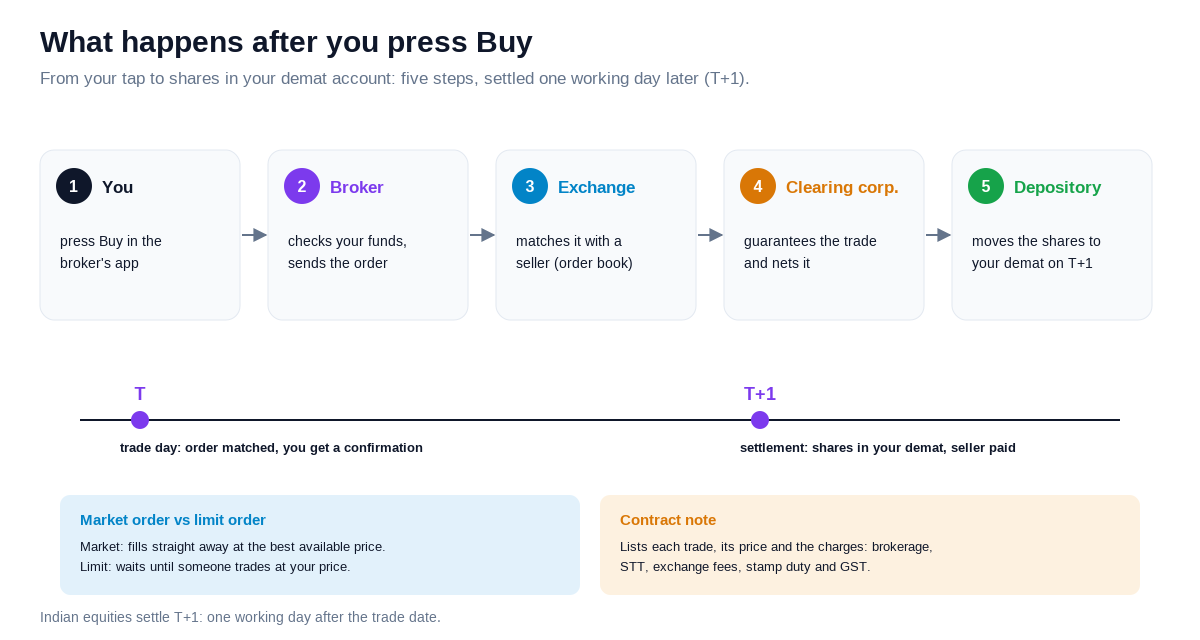
The moment you press Buy, your broker checks two things. Do you have enough funds, and is the order valid? If both are fine, it sends the order on to the exchange, which is NSE or BSE.
2. The exchange finds you a seller
For each stock the exchange keeps an order book with every buy and sell order in it. A market order gets matched straight away at the best price available. A limit order waits until someone's willing to trade at your price. Once it's matched, the trade is executed and you get a confirmation.
3. The clearing corporation stands behind it
After the trade goes through, a clearing corporation steps in between buyer and seller. It works out who owes what and guarantees the trade will settle. You never have to depend on the stranger on the other side.
4. Settlement happens on T+1
Indian equities settle on a T+1 basis. That means money and shares change hands one working day after the trade date, which is called T. On settlement the seller's shares move through the depository into your demat account, and the seller gets the money.
5. The paperwork you get
For each trading day your broker sends a contract note. It lists your trades and prices, plus charges like brokerage, securities transaction tax, exchange fees, stamp duty and GST. Separately, the depository sends a statement showing the shares in your demat account.
Some ideas to try (not promises)
These are ideas to study, paper-trade and backtest. They aren't recommendations or signals and they don't promise any result. Knowing how a trade settles helps you avoid mistakes, but it says nothing about what to buy. Size, entries, exits and risk are your own call.
1. Use a limit order on thinly traded stocks
A market order fills at the best price available, and when only a few sellers are waiting that can be far from the last price. A limit order waits for your price, so you never pay more than you set.
2. Remember settlement is T+1
Shares you buy today reach your demat account on the next working day. It's also worth checking your broker's rules on when you can withdraw sale money.
3. Actually read the contract note
Add up the brokerage, STT, exchange fees, stamp duty and GST for each trade. On very small trades, fixed charges can eat a big share of any gain.
4. Keep an eye on the pre-open session
The pre-open session starts at 9:00 am and shows where the opening price is forming. You can see pre-open data on Unfluke's Market Info page. If there's a big gap between yesterday's close and the pre-open price, take extra care with orders at the open.
How can you test these?
For your next few trades, write down the price you expected, the price you got and the total charges from the contract note. Then see which order type worked better for you.
Where to go next
Read demat, trading and bank accounts explained next, or how the pre-open session works. You can start learning on Unfluke free.
More from the blog
- How Strategy Backtesting Works on Unfluke
Test equity, Nifty, Bank Nifty and options strategies on real Indian market data, with costs included and the metrics that tell you if a rule holds up.
- Live Market Scanners on Unfluke
Scan 1,800+ NSE stocks live with Unfluke. Mix 40+ technical indicators with fundamental filters, F&O data and your own rules, then get alerts on matches.
- The Option Strategy Simulator
Build multi-leg options strategies on Unfluke, see the payoff, Greeks, max profit and max loss, and replay them on real option data from 2023.