Stock Market Basics
How the Stock Market Works, Told Through a Sabzi Mandi
8 min read · Updated 2 Nov 2026
Think about your local sabzi mandi. Lots of buyers and sellers turn up, and prices shift through the day depending on how much is on offer and how many people want it. The stock market isn't that different.
We'll use that picture to go through the main pieces of the Indian stock market, one at a time.
The market yard is the stock exchange
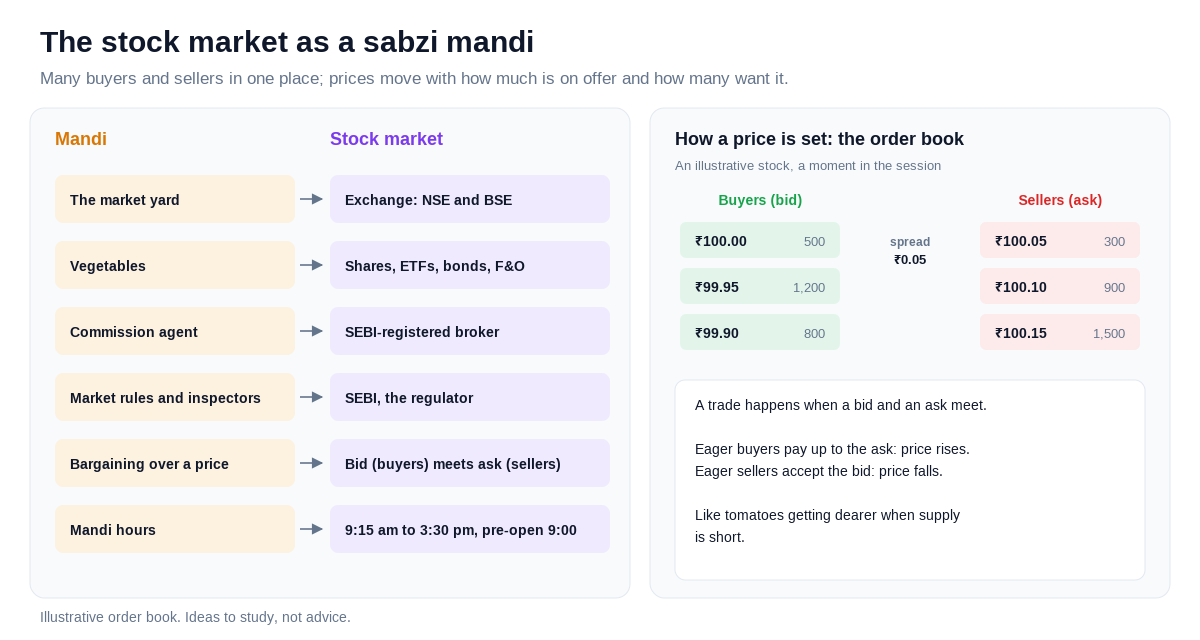
In our mandi, the exchange plays the part of the market yard. India has two main stock exchanges, the National Stock Exchange or NSE, and BSE. They run the system where buy and sell orders meet, and they publish prices so everyone can see them.
What's on sale? Shares
The stock market doesn't trade vegetables, of course. It trades shares, which are small slices of ownership in listed companies. You can also trade other instruments there, like ETFs, bonds, and futures and options.
Brokers are the middlemen
You can't just walk onto the exchange yourself. You trade through a SEBI-registered broker who passes your orders on to the exchange. It's a lot like a commission agent dealing for you in a mandi.
So how does a price get set?
Every stock has buyers quoting what they'll pay, which is the bid, and sellers quoting what they want, which is the ask. When the two meet, a trade happens. Eager buyers pay up and the price rises. Eager sellers accept less and it falls. It's the same reason tomatoes get dearer when supply is short.
SEBI keeps the rules
The market is regulated by the Securities and Exchange Board of India, better known as SEBI. It sets the rules for exchanges, brokers and listed companies, and it works to protect investors from fraud and unfair practices.
When is the market open?
On NSE and BSE the normal equity session runs from 9:15 am to 3:30 pm on weekdays, apart from exchange holidays. Before that there's a short pre-open session from 9:00 am that helps set the opening price.
Some ideas to try (not promises)
These are ideas to study, paper-trade and backtest. They aren't recommendations or signals and they don't promise any result. Knowing how prices form won't tell you where they go next. Size, entries, exits and risk are your own call.
1. Check the bid and ask before you order
The gap between the best bid and the best ask is called the spread. A small spread means lots of buyers and sellers. A wide one means a thin market, and there a limit order stops you paying far more than the last price.
2. Spot when supply and demand shift
Unfluke's Movers page lists volume gainers, which are stocks trading far more shares than usual. Heavy volume along with a big price move means a lot of people changed their minds at once.
3. Know the timings
Pre-open starts at 9:00 am and the normal session runs from 9:15 am to 3:30 pm. The first and last minutes tend to be the busiest, and often the jumpiest.
4. Check who you're trading through
Make sure your broker is registered with SEBI. The rule keeper can only protect you inside the regulated market.
How can you test these?
Watch one liquid stock and one thinly traded stock for a session. Note their spreads and volumes, and see how differently their prices moved.
Where to go next
Read what a share is next, or what happens after you press Buy. You can start learning on Unfluke free.
More from the blog
- How Strategy Backtesting Works on Unfluke
Test equity, Nifty, Bank Nifty and options strategies on real Indian market data, with costs included and the metrics that tell you if a rule holds up.
- Live Market Scanners on Unfluke
Scan 1,800+ NSE stocks live with Unfluke. Mix 40+ technical indicators with fundamental filters, F&O data and your own rules, then get alerts on matches.
- The Option Strategy Simulator
Build multi-leg options strategies on Unfluke, see the payoff, Greeks, max profit and max loss, and replay them on real option data from 2023.