Stock Market Basics
What is a Share? Owning a Piece of a Company, Explained Simply
7 min read · Updated 2 Nov 2026
Picture a pizza cut into eight slices. If one slice is yours, you own an eighth of the pizza. A share is pretty much that, except the pizza is a company.
So why do companies sell these slices, and what do you actually get when you hold one? That's what we'll cover here.
Owning a share means owning part of the company
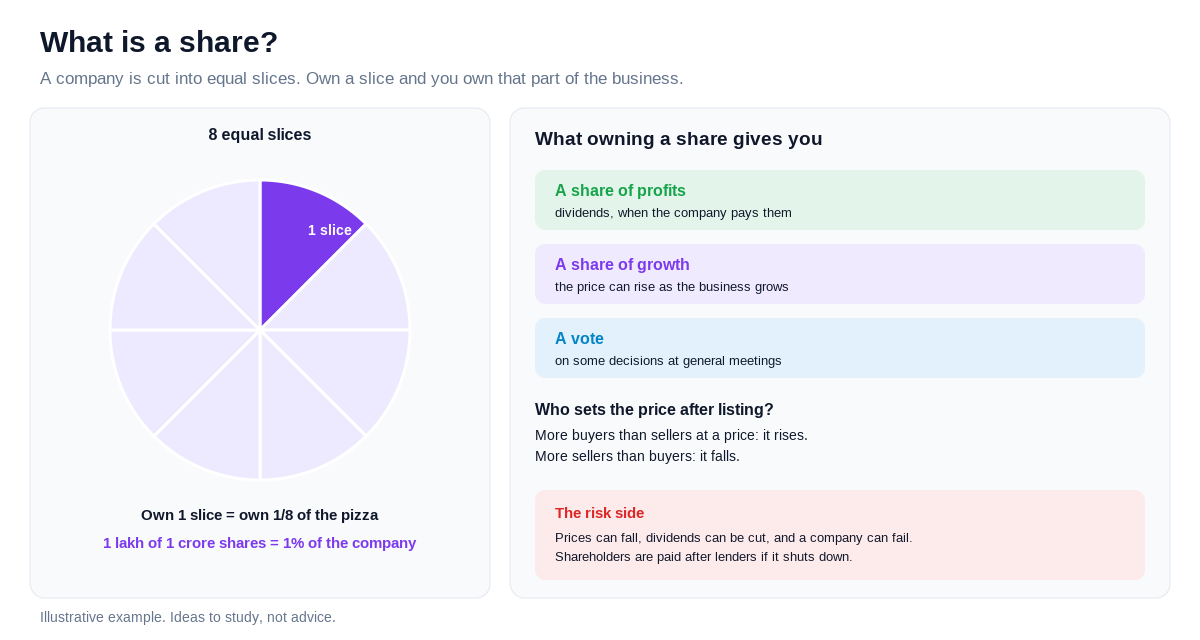
A company's ownership is split into a fixed number of equal units, and each one is a share. Say a company has 1 crore shares and you hold 1 lakh. You own 1% of it. People often use share, stock and equity to mean the same thing.
Why would a company sell shares?
It's a way to raise money for growth without taking a loan. That money might go into new factories or products, or into paying down debt. The first time a company sells shares to the public is called its Initial Public Offering, or IPO. After that the shares are listed on an exchange and investors buy and sell them among themselves.
What you get as a shareholder
You get a share of the profits, because companies may pay part of what they earn to shareholders as dividends. You also share in the growth. If the company becomes more valuable, the share price can rise. And you get a vote on certain company decisions at general meetings.
Who decides the price?
Once a share is listed, buyers and sellers on the exchange set its price. When more people want to buy than sell at the current price, it goes up. When more want to sell, it comes down. Over the long run prices tend to follow how much the business earns. In the short run they can swing on news and sentiment.
Now the risky part
Owning part of a business means you share its bad years too. Prices can fall and dividends can be cut. A company can even fail, and if it shuts down, shareholders only get paid after lenders.
Some ideas to try (not promises)
These are ideas to study, paper-trade and backtest. They aren't recommendations or signals and they don't promise any result. Owning part of a business means sharing its bad years too. Size, entries, exits and risk are your own call.
1. Work out what you really own
Divide the shares you hold by the company's total shares. Holding 1 lakh shares of a company with 1 crore shares means you own 1% of it.
2. Look at the dividend record
Check how much the company has paid out per share over several years, along with its dividend yield. A steady record tells you more than one big payout.
3. Keep the business and the price apart
In the short run the price moves on news and mood. Over years it tends to follow what the business earns. A good check is how EPS has moved alongside the price.
4. Spread the risk
Any one company can have a bad year, or fail outright. If you own several businesses, or an index fund, no single failure decides how things turn out.
How can you test these?
Pick one company you know. Find its total shares, its dividend history and its EPS over five years, and compare how its price moved against its earnings.
Where to go next
Read how the stock market works next, or how to read the IPO calendar. You can start learning on Unfluke free.
More from the blog
- How Strategy Backtesting Works on Unfluke
Test equity, Nifty, Bank Nifty and options strategies on real Indian market data, with costs included and the metrics that tell you if a rule holds up.
- Live Market Scanners on Unfluke
Scan 1,800+ NSE stocks live with Unfluke. Mix 40+ technical indicators with fundamental filters, F&O data and your own rules, then get alerts on matches.
- The Option Strategy Simulator
Build multi-leg options strategies on Unfluke, see the payoff, Greeks, max profit and max loss, and replay them on real option data from 2023.