Market Terminal
Long Unwinding in F&O: How It Is Usually Read
7 min read · Updated 2 Nov 2026
Long Unwinding - falling price with falling open interest - means existing long positions are being closed. It is one of the four cards on Unfluke's OI Buildup page.
It is the quietest of the four categories, and often the first to show that participation behind an up-move is fading.
How long unwinding differs from short buildup
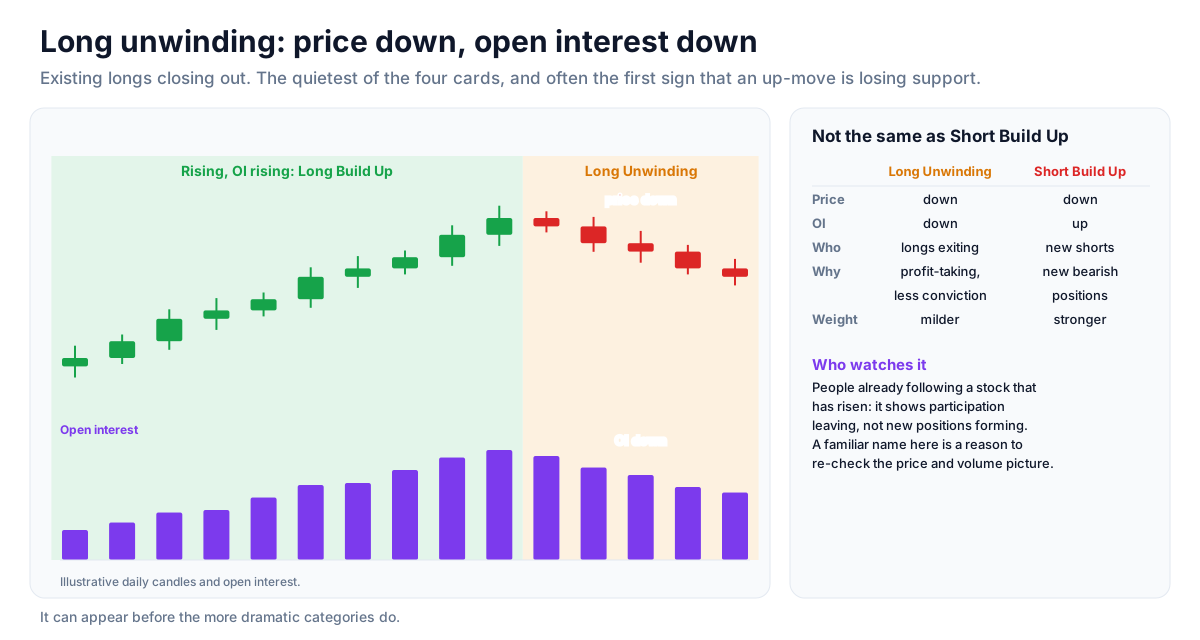
Short Build Up reflects new bearish positions. Long Unwinding instead reflects existing longs exiting - profit-taking or reduced conviction rather than new bearish positions. It is usually read as a milder change, but it can appear before the more dramatic categories do.
Who tends to watch it
Long Unwinding is most relevant to people already following a stock that has risen, because it describes participation leaving rather than new positions forming. Seeing a familiar name appear in this card is commonly treated as a reason to re-examine the recent price and volume picture.
Routine vs persistent unwinding
Some unwinding after a sharp rise is normal. Analysts pay more attention when it repeats across several sessions, or when % Chg OI keeps falling while the stock's sector still looks strong on the Heatmap - a divergence between a weakening stock and a firm sector.
What can follow
Persistent long unwinding sometimes turns into short buildup if bearish positioning develops, or simply stabilises if it was routine position closing. Checking which card the stock appears in over the following sessions shows which of these is happening.
Strategy ideas (ideas, not promises)
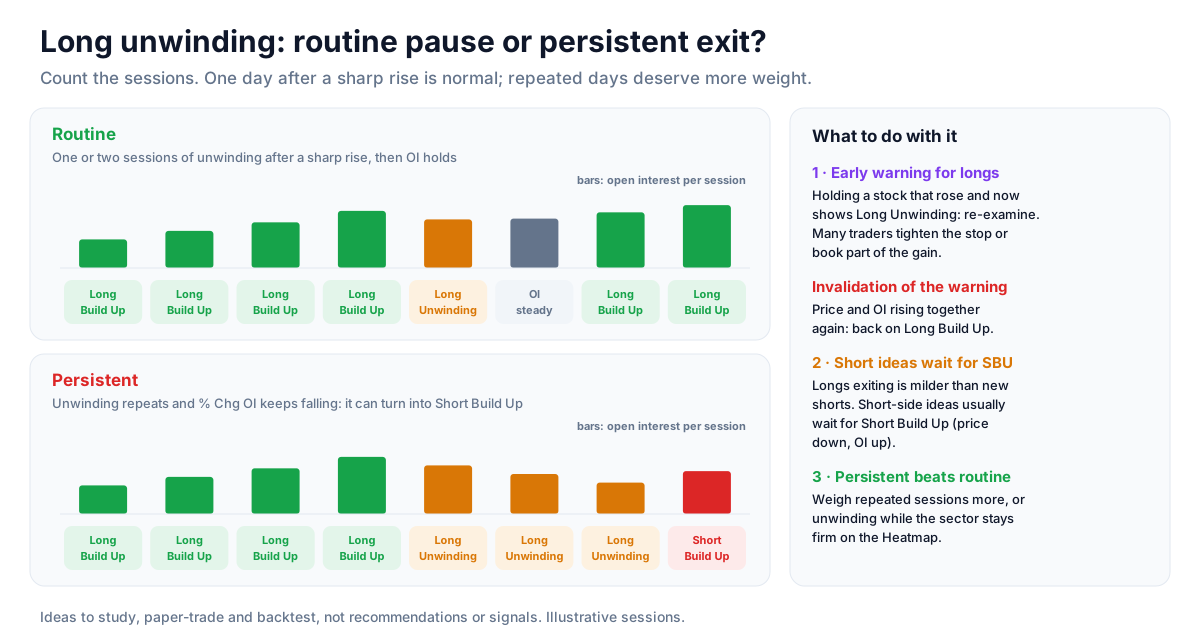
These are ideas to study, paper-trade and backtest, not recommendations or signals, and not a promise of any result. Unwinding describes longs leaving; it does not say how far price will fall. Size, entries, exits and risk are your own decisions.
1. An early warning for longs
- Setup: a stock you hold long, after a rise, appearing on Long Unwinding.
- Idea: re-examine the position: many traders tighten the stop or book part of the gain.
- Invalidation: price and OI rising together again: the name back on Long Build Up.
2. Prefer short buildup for short ideas
- Reading: falling price with falling OI is longs exiting, a milder signal than new shorts. Short-side ideas usually wait for Short Build Up (price down, OI up).
3. Persistent beats routine
- Reading: one session of unwinding after a sharp rise is normal; repeated sessions, or unwinding while the sector stays firm on the Heatmap, deserve more weight.
How to test these
Pick past dates on the OI Buildup page and follow Long Unwinding names over the next sessions: which stabilised and which moved into Short Build Up.
Where to go next
Return to long buildup vs short buildup and short covering for the full picture. Try the OI Buildup page free.
How to Read This Data
OI buildup combines the change in price with the change in open interest. Four combinations are commonly named: long buildup (price up, OI up), short buildup (price down, OI up), short covering (price up, OI down) and long unwinding (price down, OI down).
- Read price change and OI change together for the same contract and expiry.
- Use the four categories to describe whether positions were being added or closed.
- Compare the size of the OI change with the contract's total open interest.
- Compare the futures reading with the underlying stock's own price action.
Limitations: The categories are interpretations, not facts about who traded. Hedging, rollovers and spread positions can produce the same pattern for different reasons.
More from the blog
- Strategy Backtesting on Unfluke
Backtest trading strategies on real Indian market data with Unfluke. Test equity, Nifty, Bank Nifty and options strategies with realistic costs and key metrics.
- Live Market Scanners
Explore Unfluke's real-time stock scanner for NSE markets. Scan 1,800+ stocks with 40+ technical indicators, fundamental filters, F&O data and custom rules.
- Option Strategy Simulator
Build and simulate multi-leg options strategies with Unfluke. Visualize payoffs, Greeks, max profit and loss, and replay historical option data from 2023.