Market Terminal
Short Covering in F&O: What It Can Indicate
7 min read · Updated 2 Nov 2026
Short Covering - rising price with falling open interest - happens when traders who held short positions close them. Unfluke's OI Buildup page tracks it as its own card.
This article explains how short covering is usually interpreted and what to check alongside it.
Why short covering is watched around turning points
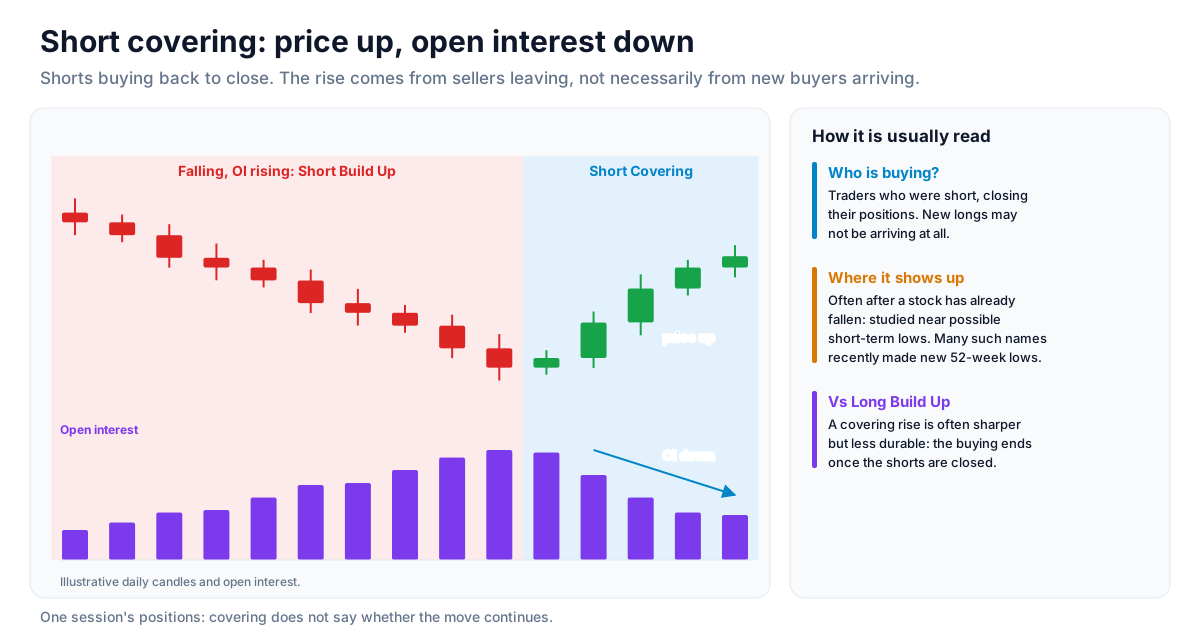
Falling OI with rising price means shorts are buying back to close, not necessarily that new longs are arriving. This often happens after a stock has already fallen and short sellers start closing their positions, which is why short covering is commonly studied near potential short-term lows.
Short covering vs long buildup
A covering-driven rise is often sharper but less durable than long buildup, because the buying pressure ends once the shorts are closed. A common check is whether OI stabilises or starts rising again in the following sessions - if it does, the stock may move into the Long Build Up card, suggesting new long participation.
Context from the 52-Week page
Many short-covering names have recently made new lows. The 52-Week High/Low page and the new 52-week lows article add that context, so the OI data is not read in isolation.
Limits of the data
Short covering describes what positions did in one session. It does not tell you whether the move will continue, and covering rallies can fade quickly. It is best treated as a prompt for further research alongside price, volume and the other OI categories.
Strategy ideas (ideas, not promises)
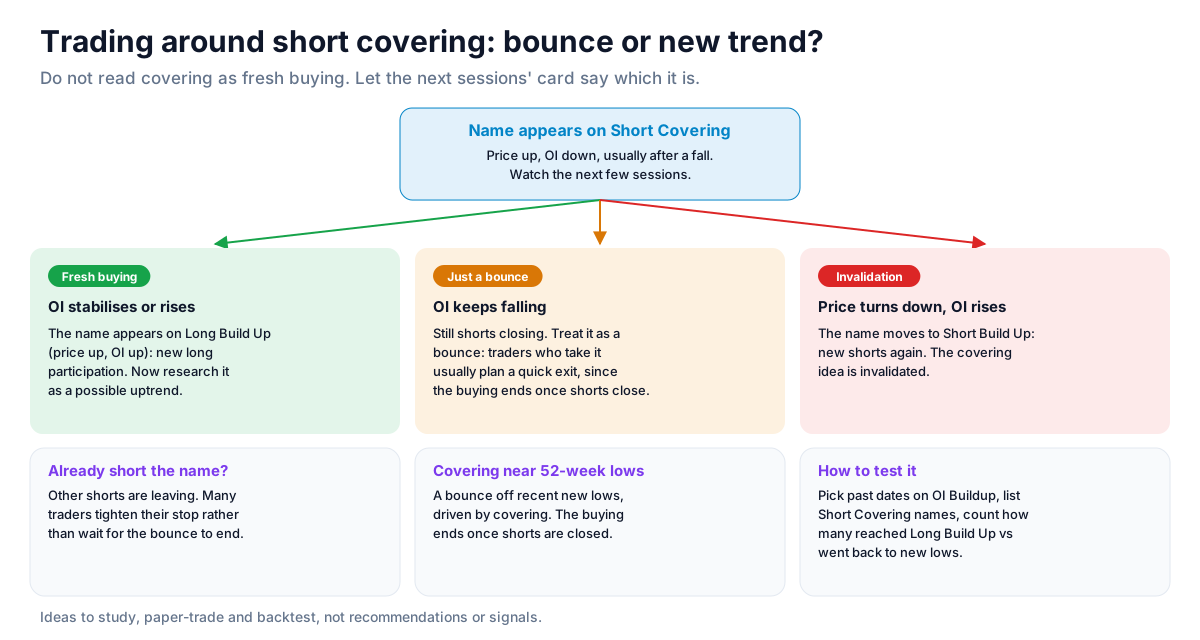
These are ideas to study, paper-trade and backtest, not recommendations or signals, and not a promise of any result. Covering rallies can be sharp and short-lived. Size, entries, exits and risk are your own decisions.
1. Do not read covering as a new uptrend
- Setup: a stock that fell and now appears on Short Covering (price up, OI down).
- Idea: wait for open interest to stabilise or rise and for the name to appear on Long Build Up before treating it as fresh buying.
- Invalidation: price turning down again with OI rising: Short Build Up.
2. Covering near 52-week lows
- Setup: short covering in a name that recently made new lows on the 52-Week page.
- Reading: a bounce off the lows driven by covering; traders who take it usually plan a quick exit, since the buying ends once shorts are closed.
3. A warning for existing shorts
- Reading: if you are short a name and it shows up on Short Covering, other shorts are leaving; many traders tighten their stop rather than wait.
How to test these
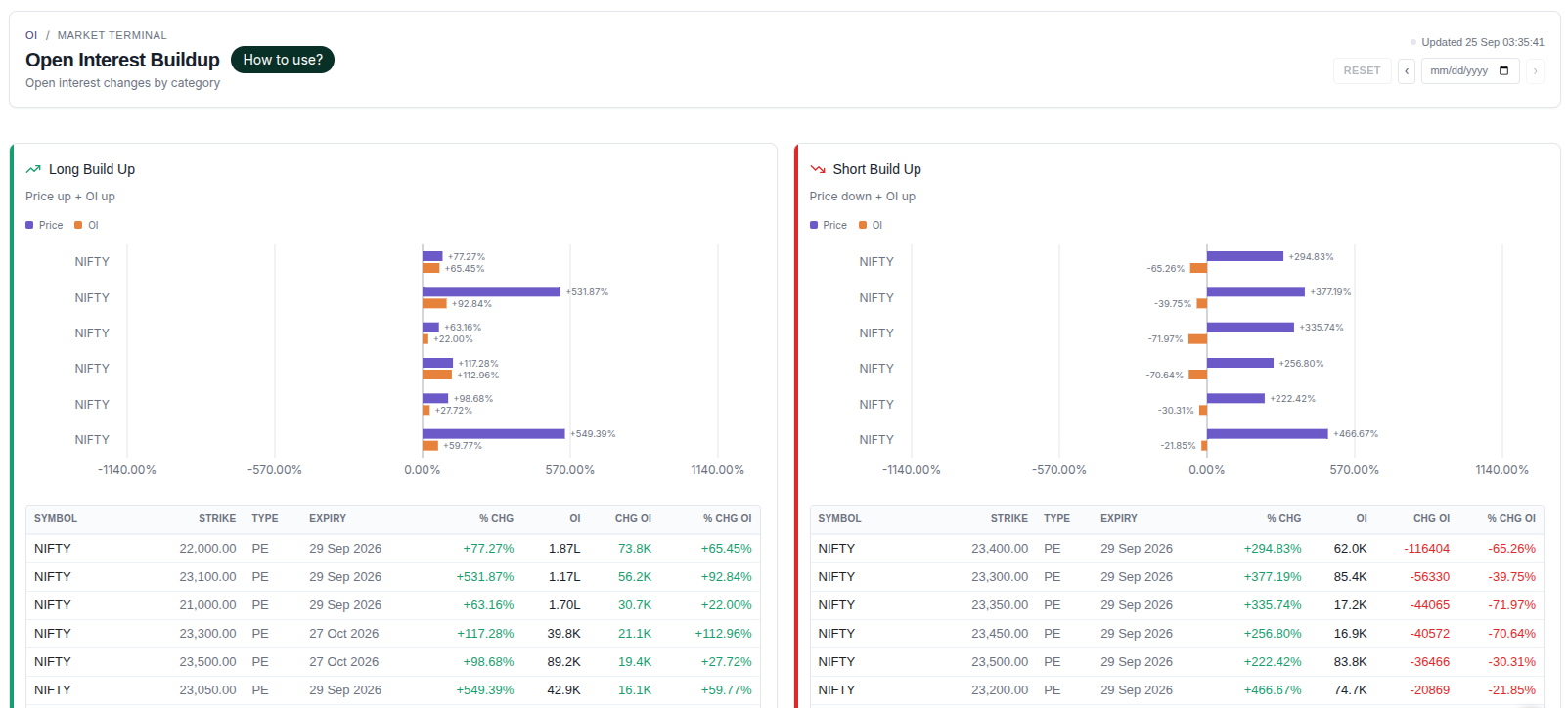
Pick past dates on the OI Buildup page, list the Short Covering names, and track how many went on to Long Build Up versus back to new lows.
Where to go next
Read long unwinding for the mirror case, or return to the derivatives data guide. Try the OI Buildup page free.
How to Read This Data
OI buildup combines the change in price with the change in open interest. Four combinations are commonly named: long buildup (price up, OI up), short buildup (price down, OI up), short covering (price up, OI down) and long unwinding (price down, OI down).
- Read price change and OI change together for the same contract and expiry.
- Use the four categories to describe whether positions were being added or closed.
- Compare the size of the OI change with the contract's total open interest.
- Compare the futures reading with the underlying stock's own price action.
Limitations: The categories are interpretations, not facts about who traded. Hedging, rollovers and spread positions can produce the same pattern for different reasons.
More from the blog
- Strategy Backtesting on Unfluke
Backtest trading strategies on real Indian market data with Unfluke. Test equity, Nifty, Bank Nifty and options strategies with realistic costs and key metrics.
- Live Market Scanners
Explore Unfluke's real-time stock scanner for NSE markets. Scan 1,800+ stocks with 40+ technical indicators, fundamental filters, F&O data and custom rules.
- Option Strategy Simulator
Build and simulate multi-leg options strategies with Unfluke. Visualize payoffs, Greeks, max profit and loss, and replay historical option data from 2023.