Market Terminal
Long Buildup vs Short Buildup: Open Interest Analysis Guide
10 min read · Updated 2 Nov 2026
The OI Buildup page sorts F&O contracts into four categories - Long Build Up, Short Build Up, Short Covering and Long Unwinding - based on how price and open interest changed.
This article explains what open interest is, how to read each card and table, and how the long buildup and short buildup categories are usually interpreted.
What is OI buildup?
The four buildup categories
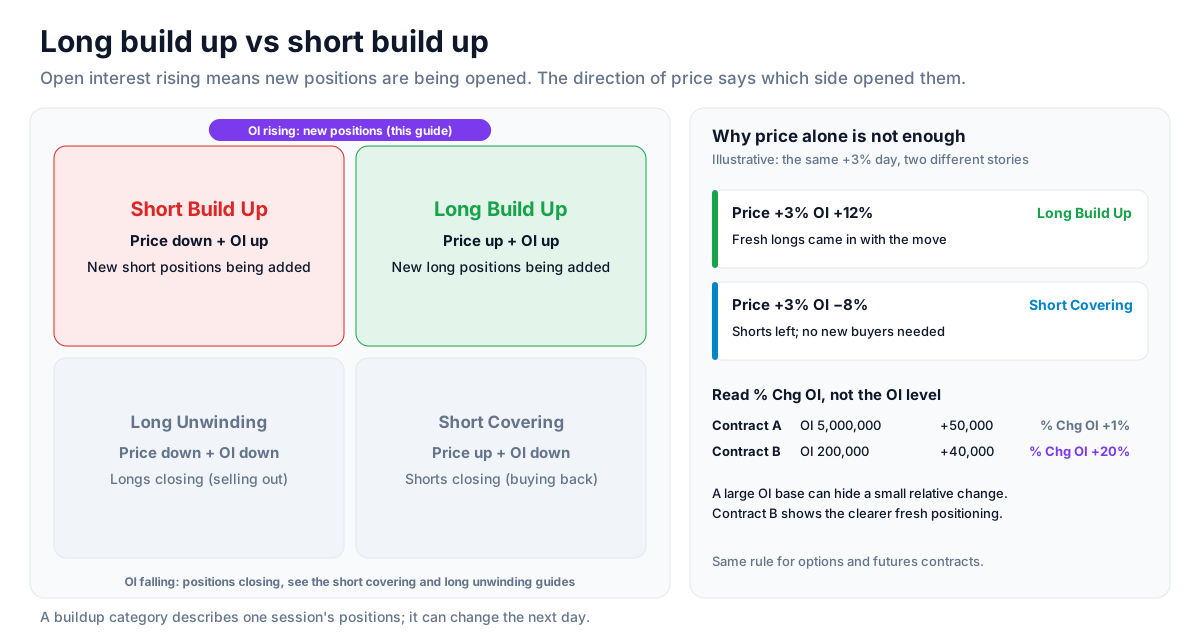
Open interest (OI) is the number of F&O contracts that are still open. When OI rises, new positions are being created; when it falls, existing positions are being closed. Combining the direction of OI with the direction of price gives four standard categories:
- Long Build Up - price up, OI up.
- Short Build Up - price down, OI up.
- Short Covering - price up, OI down.
- Long Unwinding - price down, OI down.
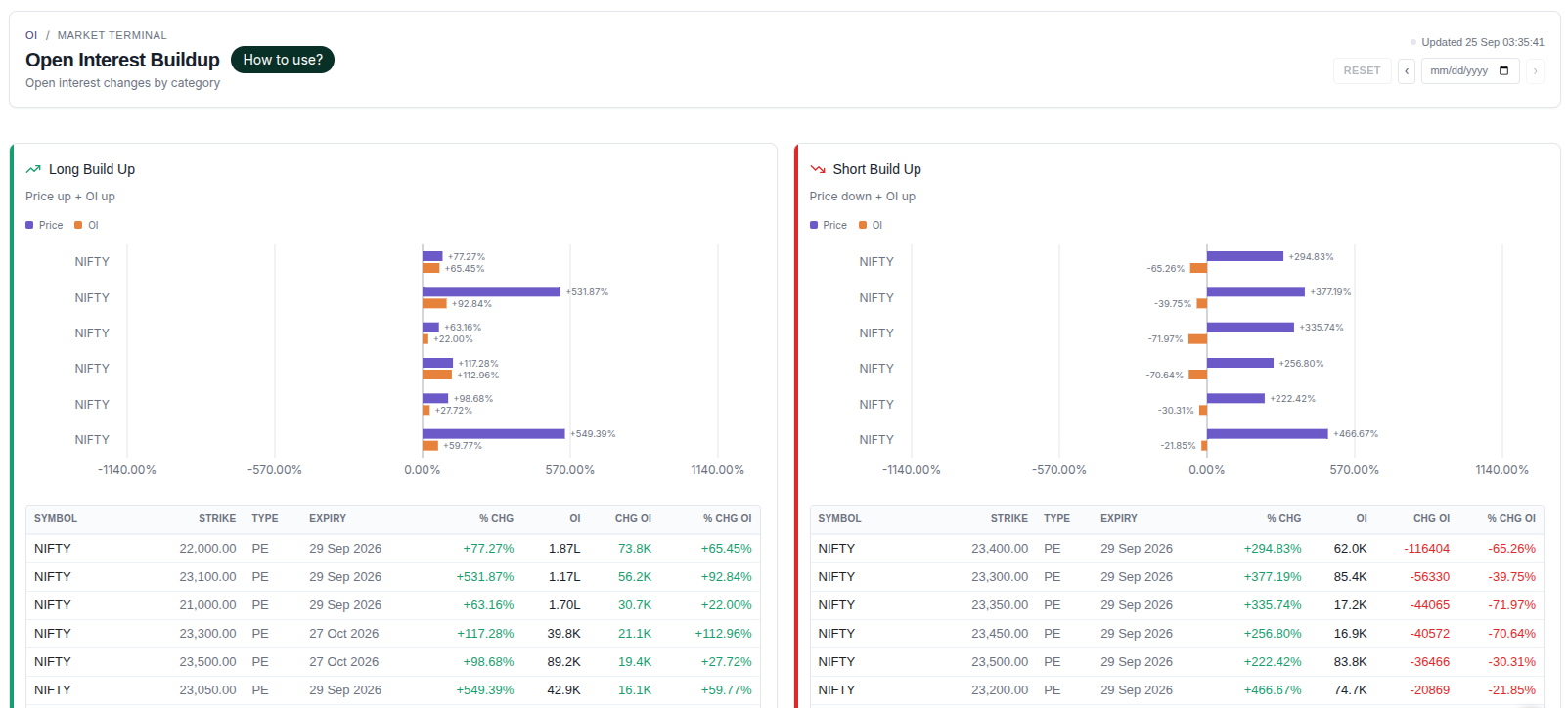
Unfluke's page shows one card per category. With no date picked it reads NSE's live lists; pick a date to see the stored list for that session.
How to read it
- Cards - one per category, labelled with its rule (for example "Price up + OI up").
- Chart - the top 6 contracts in the card, with price % change and OI % change drawn side by side on a symmetric axis, so you can see both moving the same way.
- Symbol - the underlying.
- Strike and Type - the strike and CE/PE for option contracts, or FUT for futures.
- Expiry - the contract's expiry date.
- % Chg - price change versus the previous session, in percent.
- OI - current open interest.
- Chg OI / % Chg OI - change in open interest versus the previous session, as a number and in percent.
How to use it
Start with the card that matches the question you are researching, use the chart to spot the contracts where both price and OI moved clearly, then check the table for expiry and % Chg OI. A useful habit is to look up the same symbol in the other three cards and on the Movers page, so a single category is read in context rather than on its own.
Why price alone is not enough
A rising futures price can come from new long positions or from short sellers closing out. Those two situations are often read differently. Long Build Up - rising price with rising OI - is usually interpreted as fresh participation on the long side - more information than the price movement alone gives.
Reading Long Build Up
Contracts near the top of the Long Build Up card show the largest combined rise in price and OI. A common reading is that these names are attracting new long positions. They are often compared with the Volume Gainers list and pay attention to % Chg OI rather than the absolute OI level, since a large OI base can hide a small relative change.
Reading Short Build Up
Short Build Up is the mirror case - falling price with rising OI, usually read as new short positions being added alongside a falling price. The Expiry column adds context: buildup concentrated in the nearest expiry reflects shorter-term positioning than buildup spread across later expiries.
Strategy ideas (ideas, not promises)
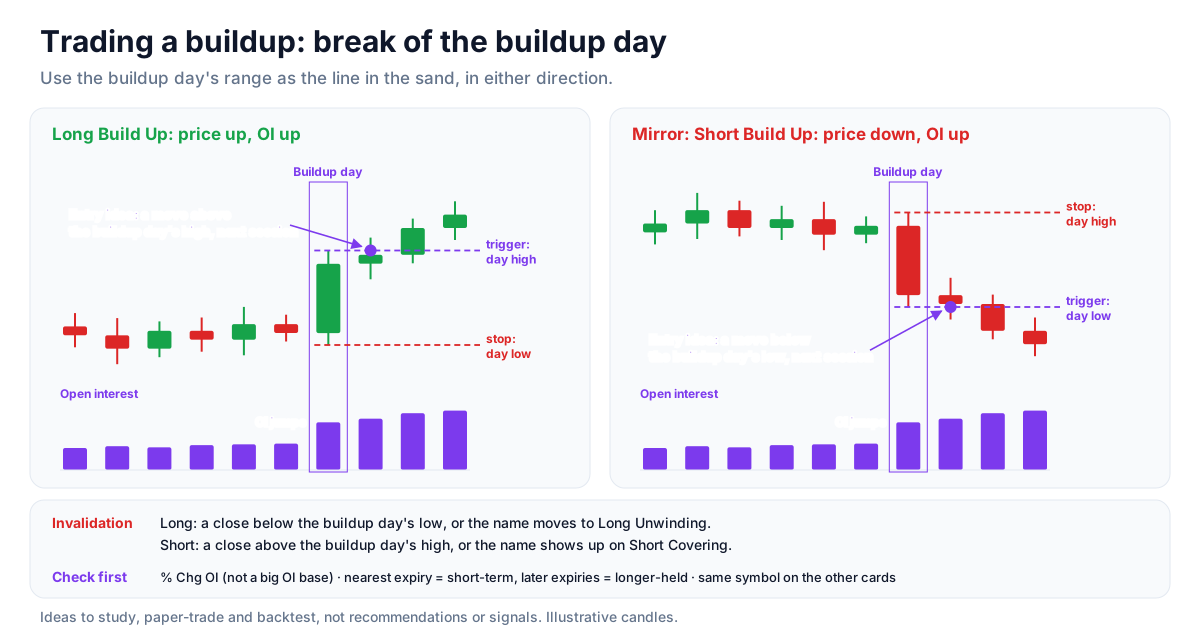
These are ideas to study, paper-trade and backtest, not recommendations or signals, and not a promise of any result. A buildup category describes one session's positions; it can change the next day. Size, entries, exits and risk are your own decisions.
1. Follow a clear long buildup
- Setup: a contract on the Long Build Up card with a clear % Chg OI, not just a large OI base.
- Entry idea: a move above the buildup day's high in the next session.
- Invalidation: a close below the buildup day's low, or the name moving to Long Unwinding.
2. The mirror for weakness: short buildup
- Setup: Short Build Up: price down with OI up, new shorts being added.
- Reading: the same rules upside down; the move is undone if the name shows up on Short Covering.
3. Read the expiry
- Reading: buildup concentrated in the nearest expiry is short-term positioning; buildup spread into later expiries points to longer-held views.
4. Cross-check before acting
- Idea: look up the same symbol on the other three cards and on the Movers page; a long buildup that also tops volume gainers carries more weight.
How to test these
Pick a date on the OI Buildup page to load that session's stored lists, note the top names in each card, then check how they moved over the next few sessions.
Where to go next
Read the other two categories next: short covering and long unwinding. Try the OI Buildup page free.
How to Read This Data
OI buildup combines the change in price with the change in open interest. Four combinations are commonly named: long buildup (price up, OI up), short buildup (price down, OI up), short covering (price up, OI down) and long unwinding (price down, OI down).
- Read price change and OI change together for the same contract and expiry.
- Use the four categories to describe whether positions were being added or closed.
- Compare the size of the OI change with the contract's total open interest.
- Compare the futures reading with the underlying stock's own price action.
Limitations: The categories are interpretations, not facts about who traded. Hedging, rollovers and spread positions can produce the same pattern for different reasons.
More from the blog
- Strategy Backtesting on Unfluke
Backtest trading strategies on real Indian market data with Unfluke. Test equity, Nifty, Bank Nifty and options strategies with realistic costs and key metrics.
- Live Market Scanners
Explore Unfluke's real-time stock scanner for NSE markets. Scan 1,800+ stocks with 40+ technical indicators, fundamental filters, F&O data and custom rules.
- Option Strategy Simulator
Build and simulate multi-leg options strategies with Unfluke. Visualize payoffs, Greeks, max profit and loss, and replay historical option data from 2023.