Market Terminal
Lock-in Expiry Calendar: When Anchor, Pre-IPO and Promoter Shares Become Free to Sell
10 min read · Updated 9 Nov 2026
When a company lists, most of its shares cannot be sold yet. Anchor investors who bought before the issue opened, shareholders from before the IPO, and the promoters are all locked in for set periods. When a lock-in ends, a block of shares that could not trade can suddenly be sold, and newly listed stocks often trade nervously into those dates.
The Lock-in Expiry Calendar lists those dates for main-board IPOs, with the issue price and how far the stock now sits from it. This guide explains SEBI's lock-in rules, how the page estimates each date (and what it cannot know), reads real rows from 9 November 2026, and turns it into a checklist.
What a lock-in is, and the SEBI periods
Why shares are locked in
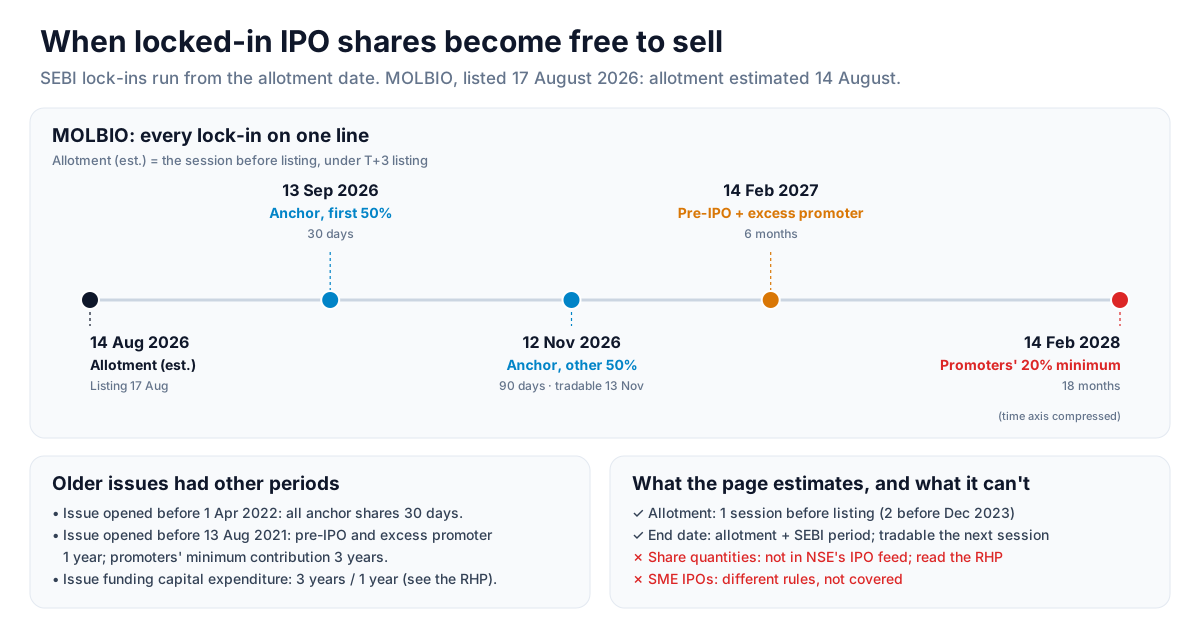
SEBI's ICDR Regulations lock in certain IPO shares so the people closest to the company, and the large investors who anchor the book, cannot sell to new public shareholders on day one. The lock-in runs from the date of allotment of the IPO shares, a few days before listing.
The periods the page uses (main board)
- Anchor investors: 50% of their shares are locked for 30 days and the other 50% for 90 days. For issues that opened before 1 April 2022, all anchor shares were locked for 30 days.
- Pre-IPO shareholders, and promoters' holding above the 20% minimum: 6 months. For issues that opened before 13 August 2021, 1 year.
- Promoters' minimum contribution (20% of the post-issue capital): 18 months. For issues before 13 August 2021, 3 years.
One exception the page cannot see: where the issue's money funds capital expenditure, the promoters' minimum contribution stays locked for 3 years and the excess for 1 year. The offer document says which applies.
How the page estimates the date
NSE's IPO data gives the issue's opening date and its listing date, but not the allotment date. The page works it out:
- Allotment = one trading session before listing for listings from 1 December 2023 (T+3 listing became mandatory then), and two sessions before for earlier ones (T+6).
- Lock-in ends = allotment + 30 or 90 days, or + 6, 12, 18 or 36 calendar months, by the rules above.
- Tradable from = the first trading session after the lock-in ends.
So every date on the page is marked (est.). It is usually right to the day, but a delayed allotment or a different lock-in in the offer document can move it.
What the page does not know
The number of shares released is not available. NSE's IPO feed carries no lock-in quantities, so the page tells you which group of holders is freed ("50% of anchor shares", "Promoters' 20% minimum contribution") but not how many shares that is. For the size, read the issue's red herring prospectus (RHP) or the company's latest shareholding filing. SME IPOs are not covered at all: their lock-in rules differ.
Reading real rows: 9 November 2026
On 9 November 2026, with the default "Next 90 days" and "Last 30 days", the page listed 99 upcoming expiries: 55 anchor, 19 pre-IPO and excess promoter, and 25 promoter minimum contribution. 8 fell in the next 7 days and 30 in the next 30. Of the 99, 43 stocks were trading below their issue price.
MOLBIO: the 90-day anchor lock-in, three days away
- IPO opened 10 August 2026; listed Monday 17 August.
- Allotment (est.): Friday 14 August, the session before listing.
- Lock-in ends (est.): 12 November 2026 (14 August + 90 days), tradable from 13 November.
- Lock-in: Anchor lock-in (second half), releasing the remaining 50% of anchor shares.
- Issue price ₹807, last close ₹1,339.30: +65.96% vs issue.
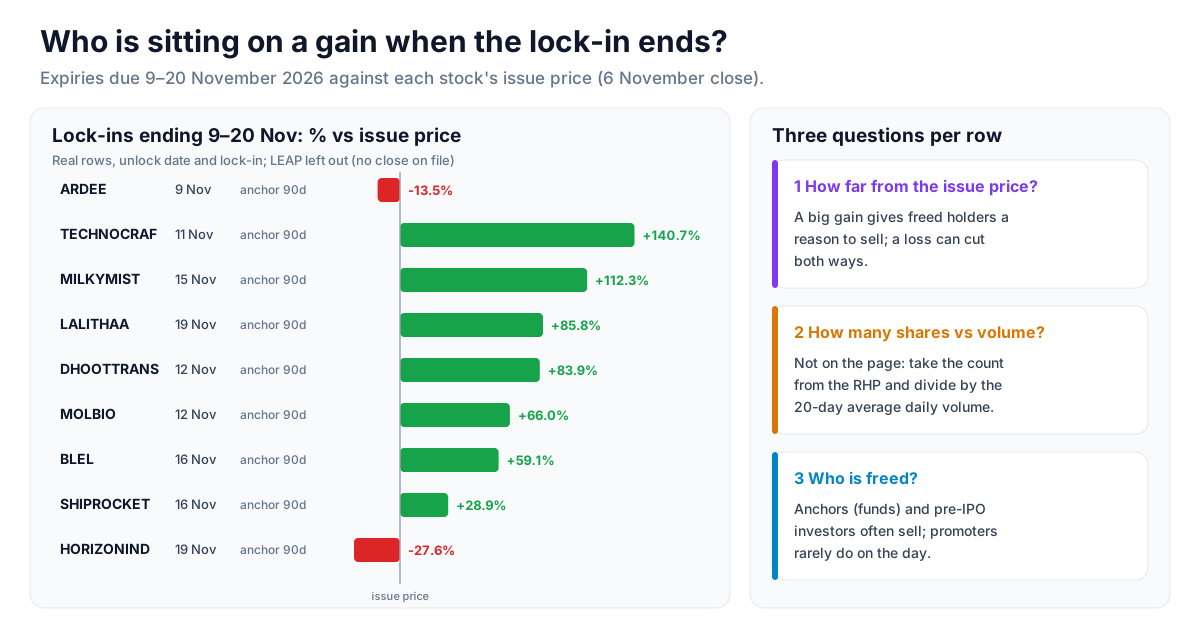
Anchors who bought at ₹807 are sitting on a 66% gain and can sell the second half of their shares from 13 November. That is the kind of row to watch: a large gain and a release of shares that could not trade before. DHOOTTRANS (issue ₹871, +83.88%) unlocks on the same day.
PRANAV: a holiday moves the dates, and holders are under water
- Listed Tuesday 15 September 2026. Monday 14 September was a market holiday, so the estimated allotment is Friday 11 September.
- First anchor half: ended 11 October (a Sunday), tradable from Monday 12 October. It now sits under "Recently expired".
- Second anchor half: ends 10 December, tradable from 11 December.
- Issue price ₹124, last close ₹84.97: −31.48% vs issue.
Here the anchors are down by almost a third. Some may hold on rather than sell at a loss; others will want out at any price. The page cannot tell you which, but it tells you the date to be ready.
ATHERENERG: an 18-month promoter release, long after listing
ATHERENERG listed on 6 May 2025 at an issue price of ₹321. Its promoters' 20% minimum contribution came out of lock-in on 5 November 2026, 18 months after the estimated 5 May 2025 allotment, and was tradable from 6 November. The stock closed at ₹1,821.70, +467.51% vs issue. Promoter releases rarely mean an immediate sale (promoters often keep their stake), but they make one possible, and any pledge or sale after that date shows up in the shareholding filings.
How to use it in a trade
Three questions for every row
- How far is the stock from its issue price? A big gain ("vs Issue" far above zero) gives the freed holders a reason to take profit. A loss can cut either way: some holders wait, others sell to cut it.
- How many shares, against how much daily trading? The page cannot give the quantity, so open the RHP (SEBI's site, Filings → Public Issues) and find the anchor allocation or the pre-IPO holdings. Compare that with the stock's average daily volume. A release of 20 days' volume matters far more than one of half a day's.
- Who is freed? Anchors are mostly mutual funds, insurers and foreign funds with a short horizon on IPO allocations. Pre-IPO investors (private equity, early backers) often have exit plans. Promoters rarely sell on the day.
Before the date
- If you hold a recent IPO, check its row before the anchor 30- and 90-day dates. Tighten stops or reduce size if a large, profitable release is close.
- Selling pressure, if any, often shows up in the sessions before the date as well as after it, as traders try to get ahead of it.
- Use the "Next 7 days" tile as a quick check each Monday.
On and after the date
- Watch volume against the 20-day average. Block or bulk deals in the stock on or after "Tradable from" are often the freed holders; check the Large Deals page.
- A stock that absorbs a big release without falling is showing demand. Some traders treat that as a sign of strength.
- The next shareholding filing confirms who actually sold.
Strategy ideas (ideas, not promises)
- Avoid the date: the simplest use. Don't open a new long in a recent IPO in the week before a large, profitable anchor release; wait to see how the stock takes it.
- Absorption entries: after a heavy release day, a stock that holds above its pre-release low and the issue price for a few sessions may be worth a closer look. Define the rule before you look at charts.
- Release size filter: keep a small sheet of upcoming rows with the RHP share count ÷ average daily volume. Act only on releases above a threshold you have tested.
- Pair with deals data: a bulk or block sale by a named anchor on the release day confirms the supply. A buyer on the other side of that block is information too.
- Backtest it: use "Recently expired" (and the 90-day option) to collect past release dates, then study the stock's moves around them before risking money on a rule.
These are ideas to study, paper-trade and backtest, not recommendations or signals, and not a promise of any result. Lock-in dates on this page are estimates and the share quantities are not shown; check the offer document. Size, entries, exits and risk are your own decisions.
Every filter, tile and column
The filters
- Ahead: Next 30 days, Next 90 days (default), Next 6 months, Next 12 months.
- Recent: None, Last 30 days (default), Last 90 days. These rows appear under "Recently expired", newest first.
- Lock-in: All, Anchor investors, Pre-IPO & excess promoter, Promoter minimum contribution. Each chip shows its number of upcoming expiries.
- CSV: every row, including the estimated allotment date and the "Shares released" description.
The tiles
- Upcoming expiries in the window picked, and how many fall in the next 7 and next 30 days.
- Trading below issue: how many of the upcoming stocks close below their issue price, holders sitting on a loss.
The columns
- Lock-in Ends (est.): the date and how many days away, with "tradable" (the next session) under it. Highlighted when it is within 7 days.
- Symbol and company.
- Lock-in: which lock-in ends and whose shares it releases.
- Listed: the listing date; hover for the estimated allotment.
- Issue Price, Last Close (with the day's change) and vs Issue: the close against the issue price.
One stock can appear several times, once for each lock-in: MOLBIO will be back on 14 February 2027 for its 6-month release.
What the dates are built from
The page reads NSE's IPO list for main-board equity issues (EQ and BE series): symbol, issue opening date, listing date and issue price. It looks back far enough (just over three years) to catch the longest lock-in, works out the allotment from the listing date and NSE's trading holidays, and applies the SEBI periods by the issue's opening date. Prices are the latest Bhavcopy close; a stock with no close (suspended or moved to another series) shows a dash. The dates are estimates and no share quantities are shown; the RHP, available from SEBI (Filings → Public Issues), is the source for both.
Where to go next
For how new listings trade from day one, read the IPO listing day guide and the main-board vs SME IPO guide; to see who is selling on the day, the bulk and block deals guide; and for changes in promoter and institutional holdings, the Shareholding Changes guide. Open the page at Calendars & Reference → Lock-in Expiry Calendar, or sign up free.
More from the blog
- Strategy Backtesting on Unfluke
Backtest trading strategies on real Indian market data with Unfluke. Test equity, Nifty, Bank Nifty and options strategies with realistic costs and key metrics.
- Live Market Scanners
Explore Unfluke's real-time stock scanner for NSE markets. Scan 1,800+ stocks with 40+ technical indicators, fundamental filters, F&O data and custom rules.
- Option Strategy Simulator
Build and simulate multi-leg options strategies with Unfluke. Visualize payoffs, Greeks, max profit and loss, and replay historical option data from 2023.